Prioritizes stable tracking and precise optics for imaging. That’s the real secret sauce when you’re hunting for the best telescope for astrophotography. It’s not just about magnification. You need a mount that can follow those stars perfectly for minutes on end, and glass that captures pin-sharp details without weird color fringes.
It can feel overwhelming, right? All those technical specs and accessories. But nailing those two fundamentals—solid tracking and crisp optics—is what transforms a frustrating night into capturing jaw-dropping images of galaxies. Let’s break down which scopes actually deliver on that promise.
Product Comparison Table: 8 Best Best Telescope For Astrophotography
| Image | Why We Like This Product | Editor’s Rating | |
 |
SVBONY SV305C Pro Telescope Camera, USB 3.0 High-Speed Transmission,…
|
9.9 |
Read Review |
 |
SVBONY SV305C Astrophotography Camera, 2.1MP IMX662 Color Telescope Camera…
|
9.6 |
Read Review |
 |
WiFi Telescope Camera Eyepiece, 64G Electronic Eyepiece Camera with…
|
9.4 |
Read Review |
 |
SVBONY SV105 Telescope Camera, 1.25″ USB2.0 IMX307 CMOS Color…
|
9.1 |
Read Review |
 |
64GB Telescope Camera Digital Eyepiece: 2K Video Recording, WiFi…
|
8.8 |
Read Review |
 |
Telescope Camera 4K, 8MP Astrophotography Camera – 1.25″ Telescope…
|
8.5 |
Read Review |
 |
4K Wireless Telescope Camera, Universal Eyepiece Camera with IR…
|
8.3 |
Read Review |
 |
Telescope Camera, 1080P Astronomy Camera, 1.25 inch Telescope Eyepiece…
|
8.0 |
Read Review |
Quick Review For Top 8 Best Telescope For Astrophotography
SVBONY SV305C Pro Telescope Camera, USB 3.0 High-Speed Transmission, 2MP IMX662 Sensor 128MB DDR Buffer, 1.25" CMOS Astrophotography Camera, Electronic Telescope Eyepiece for Astrophotography

The SVBONY SV305C Pro Telescope Camera is designed for planetary and lunar astrophotography. It’s a 1.25-inch device that replaces your telescope’s eyepiece, turning your optical tube into a powerful digital imager. At its heart is a 2MP IMX662 sensor, chosen for its high sensitivity and notably low noise performance. This combination is crucial for capturing the faint details of planets without excessive grain, even when you’re dealing with the challenging conditions of a night sky.
One of the cameras standout features is its speed. It supports a resolution of 1920×1080 at a very smooth 107 frames per second. This high frame rate is essential for “lucky imaging,” where you record a video to freeze moments of stable atmospheric seeing. It lets you capture sharp, fleeting details on fast-moving targets like Jupiter’s cloud bands or the Cassini Division in Saturn’s rings.
To handle this data flood, the USB 3.0 interface provides a 5Gbps transfer speed, which is over ten times faster than older USB 2.0 cameras. This means less waiting between captures and a much more efficient workflow. The SV305C Pro tackles common imaging headaches with specific hardware solutions. Its ultra-low readout noise of just 0.7e- means the signal from your telescope faces less electronic interference, resulting in cleaner raw data.
SVBONY SV305C Astrophotography Camera, 2.1MP IMX662 Color Telescope Camera with Removable UV IR Cut Glass, 1.25" Electronic Telescope Eyepiece for Planetary Moon Astrophotography&EAA

The SVBONY SV305C is a color astronomy camera designed to be your entry point into capturing the night sky. It’s built to handle planetary and lunar photography with ease, and it’s also a great tool for Electronically Assisted Astronomy (EAA), letting you observe celestial objects on your computer screen in real-time.
At its heart is a 2.1-megapixel IMX662 sensor. This is a back-illuminated sensor with 2.9µm pixels, which helps it gather light efficiently.
A key benefit here is its high full-well capacity, meaning it can handle bright areas like the Moon’s surface without overexposing them too easily. The sensor also boasts low readout noise and no amp glow, which contributes to cleaner images. Improvements in its near-infrared sensitivity, especially in the red band, mean it can capture richer color data from planets like Mars.
To help you get started, the camera works with popular software like SharpCap.
It comes with pre-configured one-click modes for high-speed planetary imaging and long-exposure deep sky work. You can save your own settings too, making it quick to setup for your next session. A built-in 128MB image buffer acts as a safety net; it temporarily stores frames if your computer’s USB connection hiccups, preventing lost data during important captures.
Two useful features for optimizing your shoot are the ROI and BIN functions.
WiFi Telescope Camera Eyepiece, 64G Electronic Eyepiece Camera with 1.5" Screen, Astronomy Camera Fits to 28mm- 50mm Scopes, Perfect for Astrophotography, Birds Watching

The WiFi Telescope Camera Eyepiece is a clever gadget that bridges the gap between traditional optics and the digital world. It’s essentially an electronic eyepiece that replaces the standard one on your scope, letting you see and record what you observe on a screen. This device is designed for anyone who wants to extend there experience beyond the lens, whether you’re gazing at stars or watching wildlife. Right on the device is a handy 1.5-inch IPS screen.
This gives you a immediate, high-color preview of your subject without needing your phone right away. For more flexibility, it creates its own WiFi network. You can connect your smartphone or tablet to it wirelessly, streaming a live view to your hand. This allows for remote observing within about 49 feet, which is perfect for sharing the view with a friend or watching comfortably from a short distance away. Image quality is a key focus.
The camera captures in 1080P Full HD for video and takes 2-megapixel photos. This resolution is great for detailing the moon’s craters or a bird’s plumage. It also includes a dark light compensation feature to brighten up the view in low-light conditions, making dusk observations or faint celestial objects clearer. You won’t miss a moment thanks to the built-in 1000mAh battery, which supports up to 3 hours of recording.
SVBONY SV105 Telescope Camera, 1.25" USB2.0 IMX307 CMOS Color Astrophotography Camera, Electronic Telescope Eyepiece for Telescope, Suitable for Astrophotography Beginners
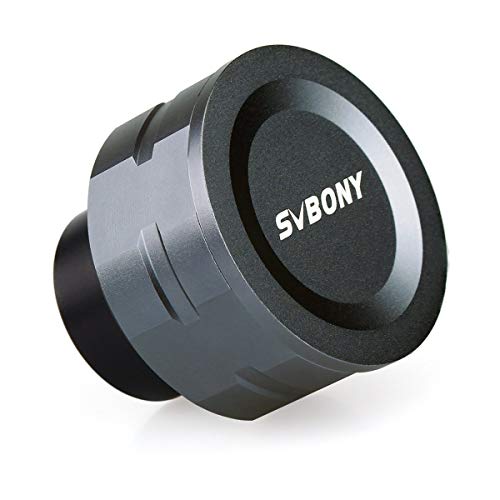
The SVBONY SV105 Telescope Camera is a 1.25-inch USB camera designed to be your first step into astrophotography. It replaces a standard telescope eyepiece, letting you capture and view celestial objects directly on your computer screen. This makes it a practical and accessible tool for beginners who are curious about imaging the night sky. This camera is primarily suited for capturing bright solar system targets. You can use it to image the Moon and planets like Jupiter and Saturn.
The process involves pointing your telescope at the target, recording a short video through the camera, and then processing that video on your computer to create a detailed, still image. It also allows for real-time observation, so you can share the live view from your telescope with others on a laptop or PC monitor, which is great for group viewing or avoiding the neck strain of peering through an eyepiece.
Setup is straightforward with a plug-and-play design for most systems; no additional drivers are typically needed. For Windows, you’ll use free software like SharpCap. Linux users can utilize AstroDMx Capture, and Android devices can work with a generic USB camera app. Importantly, the SV105 is compatible with Apple laptops running macOS, but it does not work with iPhones or iPads.
64GB Telescope Camera Digital Eyepiece: 2K Video Recording, WiFi Telescope Microscope Accessory, 25-50mm Eyepiece Adapter, Screen Support, App Control, Perfect for Astrophotography, Birds Watching

The 64GB Telescope Camera Digital Eyepiece is designed to bridge the gap between traditional observation and the digital world. If you’ve ever wanted to share what you see through your telescope or microscope, or simply save those moments for later, this accessory makes it straightforward. It’s core function is to replace a standard eyepiece, turning your optical device into a powerful digital recording tool.
Getting started is remarkably simple.
The camera features a universal adapter that fits eyepiece barrels from 25 to 50mm. You just remove your existing eyepiece, twist this one into place, and your’re ready to go—no complicated tools or technical know-how needed.
Its built-in 1500mAh battery powers over four hours of continuous use, and the USB-C port allows for convenient charging with common phone chargers, even while your using the device.
Instead of peering through a small lens, you’ll view everything on your smartphone screen. The camera creates its own WiFi hotspot, so you connect your phone directly to it without needing an internet connection.
Telescope Camera 4K, 8MP Astrophotography Camera – 1.25" Telescope Electronic Eyepiece Camera with IR Filter, Plug & Play for Astronomy, Planetary Imaging, Compatible with Windows/Mac/Linux

The Telescope Camera 4K, 8MP Astrophotography Camera is a 1.25″ electronic eyepiece designed to bridge the gap between visual observing and digital imaging. It lets you capture and share what you see through your telescope with remarkable ease and clarity.
One of it’s most significant advantages is its true plug-and-play setup. You don’t need to install any special drivers.
Just connect it to your computer via USB, and it’s automatically recognized by Windows 10/11, macOS 12+, and Linux systems. This means you can start streaming live views of the moon or planets almost instantly using any UVC-compatible software, which is a huge benefit for beginners and seasoned astronomers alike.
At its core is an 8-megapixel sensor that delivers high-quality imaging.
It records smooth video at 1080P resolution with 60 frames per second, and it can also capture 4K video at 30fps. This high-speed capability is crucial for planetary imaging, where stacking the best video frames leads to a stunning final picture.
4K Wireless Telescope Camera, Universal Eyepiece Camera with IR Filter & X16 Zoom & 2.8" Screen, Gift for Astrophotography Enthusiast (SV-EP03)

The SV-EP03 4K Wireless Telescope Camera is a tool designed to bring your observations, whether of the night sky or the natural world, onto a clear, digital screen. It bridges the gap between looking through an eyepiece and capturing what you see. At its core is an 8MP CMOS sensor capable of recording in 4K video and capturing high-resolution images. This means the details of the lunar surface, the rings of Saturn, or a distant bird are rendered with impressive clarity.
Its advanced low-light compensation technology helps ensure these visuals remain sharp and detailed, even when your subject isnt brightly lit. You get a rotatable 2.8-inch IPS mini screen right on the device. This screen provides high color accuracy and shows you a real-time electronic image, making observation more intuitive and comfortable than squinting through an eyepiece. For even more flexibility, the camera creates its own WiFi network.
You can connect your smartphone or tablet within a 32-foot range to view the feed remotely, and it supports two devices connecting at once. This is perfect for sharing the moment with a friend or family member without taking turns. Versatility is a key strength. The universal locking groove is designed to fit eyepieces from 23mm to 60mm in diameter. This means you can attach it to most astronomical telescopes, binoculars, monoculars, and even microscopes.
Telescope Camera, 1080P Astronomy Camera, 1.25 inch Telescope Eyepiece Camera with UV IR Filter, Plug & Play Astrophotography Camera for Win/Mac/Linux, USB Digital Eyepiece for Planetary Observation

The Telescope Camera 1080P is a digital eyepiece designed to bring your astronomical observations onto a screen. It replaces a traditional telescope eyepiece, allowing you to view and capture celestial objects in real-time on your computer. This makes it a practical tool for anyone wanting to step into astrophotography without overly complex equipment. Its core feature is universal compatibility and ease of use.
The camera works on a simple plug-and-play basis with Windows, Mac, and Linux systems—no tricky driver installations needed. You just connect it to your laptop via USB, and your ready to start. The camera body has a standard 1.25-inch barrel, so it fits directly into the focuser of most common telescopes, from beginner models to more advanced ones. For image quality, the camera captures high-definition 1080p video at a smooth 30 frames per second.
It uses a 2.0-megapixel CMOS sensor to deliver crisp, true-color live views of the Moon, planets, or even terrestrial subjects. The lightweight aluminum alloy construction isn’t just for durability; it also acts as a heat sink to help reduce thermal noise during longer viewing sessions, which helps maintain image clarity. A key component for clear astrophotography is the integrated UV/IR cut filter.
Best Telescope For Astrophotography Buying Guide
The best telescope for astrophotography is a complete system, not just optics. It’s about how the mount, camera, and telescope work together. Think of it as building a team where every member has a critical role. A beautiful lens on a shaky tripod will only lead to frustration and blurry stars. Let’s break down what really matters.
Mount Stability is Everything
This is the non-negotiable foundation. An equatorial mount that can track the night sky’s rotation is essential. Ask yourself: can it handle more weight than my entire setup? If the answer isn’t a clear “yes,” look for a sturdier option. A wobbly mount ruins hours of careful work in an instant.
Aperture and Focal Ratio
Bigger aperture gathers more light, revealing fainter nebulae. But focal ratio (f/) determines speed. A lower number, like f/4, is “faster”—it captures images more quickly, which is great for beginners. A higher f/ ratio is “slower” but offers more magnification for planets. You must choose based on your primary targets.
Optical Design Choices
Refractors are often recommended for starters due to their low maintenance and sharp views. Reflectors, like Newtonians, offer more aperture for the money but may need more collimation (alignment). Catadioptric telescopes are compact with long focal lengths, perfect for planets but requiring precise tracking.
Compatibility and Back Focus
Will your camera actually attach? You’ll need the right adapters to achieve “back focus,” the specific distance between the telescope and camera sensor. Getting this wrong means you’ll never achieve a sharp image across the whole frame. It’s a common, frustrating hurdle that’s easily overlooked.
Frequently Asked Questions About Best Telescope For Astrophotography
What makes a telescope good for astrophotography?
A good astrophotography telescope gathers a lot of light and has sharp optics. It also needs to work well with a sturdy mount. A fast focal ratio, like f/4 or f/5, helps capture more light quickly, which is key for deep-sky objects.
Is a refractor or reflector telescope better?
It depends on your goals. Refractors are often easier to start with and have less maintenance. Reflectors offer more aperture for your money, which is great for faint galaxies. Both types can produce excellent images with teh right setup.
Can I use any telescope mount?
No, you really can’t. A solid, motorized equatorial mount is essential. It tracks the stars’ motion perfectly during long exposures. Without this, your photos will just have blurry star trails, no matter how good your telescope is.
Do I need a special camera?
You can start with a modified DSLR, but dedicated astronomy cameras are better. They’re more sensitive to the faint light from nebulas and have cooling systems to reduce noise. This makes a huge difference in your final image quality.
How important is aperture size?
Aperture is important because it determines how much light you collect. A larger aperture lets you capture fainter details faster. But remember, a bigger telescope requires a stronger, more expensive mount to carry it steadily.
What’s a good beginner setup?
A small apochromatic refractor (70-80mm) on a robust GoTo equatorial mount is a classic start. It’s manageable and teaches you the fundamentals. Pair it with a guide scope for even sharper pictures, and your off to a great start.
Is astrophotography very expensive?
It can be, but it doesn’t have to be overwhelming. You can begin with a used DSLR and a tracker before investing in a full telescope setup. The key is to build your kit slowly, focusing on a stable mount first.
Final Take
This rig is built for capturing celestial portraits. It’s about patience and precision, not just pointing at teh sky. You’ll learn to track, focus, and wait for that perfect moment of clear, steady air. The reward is an image you made, a personal snapshot of a galaxy or nebula light-years away. It’s a fantastic way to connect with the night.
Choosing the right equipment is your first step. The best telescope for astrophotography for you balances aperture, focal length, and your own budget. Remember, a good mount is just as crucial as the optics itself. Start with a manageable setup, learn its quirks, and your skills will grow with your ambitions. Clear skies and good luck on your journey.