Stargazing is a humbling hobby, but finding the right gear can feel overwhelming. You want crisp views of Saturn’s rings or distant galaxies, not a fuzzy blob. That’s why choosing the best telescope for viewing planets and galaxies is so crucial—it’s the difference between a glimpse and genuine exploration. The right model opens up the cosmos from your backyard.
We’ve tested the top options to cut through the technical jargon. This guide focuses on what actually matters for deep-sky and planetary viewing, helping you find a scope that fits your budget and sky. Get ready to unlock those celestial wonders you’ve been dreaming of seeing up close.
Product Comparison Table: 9 Best Best Telescope For Viewing Planets And Galaxies
| Image | Why We Like This Product | Editor’s Rating | |
 |
Telescope,Telescope for Adults High Powered, 90mm Aperture 900mm Professional…
|
9.5 |
Read Review |
 |
NACATIN Astronomy Telescope for Adults & Beginners, 90mm Aperture…
|
9.3 |
Read Review |
 |
FAMIROSA Telescope for Adults High Powered, 90mm Aperture (36X-270X)…
|
9.1 |
Read Review |
 |
NACATIN Telescope 90mm EQ Refractor Telescope for Adults &…
|
8.9 |
Read Review |
 |
Bushnell Refractor 600x50mm Telescope, Deep Space Viewing Telescope 181561
|
8.7 |
Read Review |
 |
Slokey Discover The World Telescope for Astronomy for Adult…
|
8.5 |
Read Review |
 |
National Geographic Sky View 70mm Refractor Telescope with Panhandle…
|
8.3 |
Read Review |
 |
Telescope for Adults High Powered, 80mm Aperture 600mm Telescopes…
|
8.1 |
Read Review |
 |
MaxUSee Lunar Telescope for Kids and Astronomy Beginners, Refractor…
|
7.9 |
Read Review |
Quick Review For Top 9 Best Telescope For Viewing Planets And Galaxies
Telescope,Telescope for Adults High Powered, 90mm Aperture 900mm Professional Refractor Telescopes for Kids & Beginners, Magnification 450X,for Planet Observation with Stainless Tripod & Phone Adapter

The HETEKAN High-Powered 90mm Refractor Telescope is designed for anyone curious about whats up in the night sky. Whether your an adult looking for a new hobby, a beginner taking first steps, or a parent wanting to share astronomy with kids, this model makes celestial observation accessible and engaging.
Its core purpose is to bring the details of the Moon, planets, and other bright objects into clear view without overly complex setup.
At the heart of its performance is the 90mm large aperture. This opening is crucial because it gathers significantly more light than smaller scopes. That means the images you see, like the craters on the lunar surface or the rings of Saturn, appear brighter and more detailed.
The fully multi-coated optical glass lenses further enhance this by reducing glare and reflection, ensuring a crisp view thats also safer for your eyes during extended observation.
Versatility in magnification is a key feature here. With the included three eyepieces (25mm, 10mm, and 6mm) combined with the 3x Barlow lens, you can achieve magnifications from 36X all the way up to 450X. The 900mm focal length provides the necessary reach for planetary observation.
NACATIN Astronomy Telescope for Adults & Beginners, 90mm Aperture 800mm Fetal Length Portable Refractor Telescope -with Phone Adapter for Moon & Planets, Ideal Gift for Birthday/Valentine's Day, White

The NACATIN 90mm Astronomy Telescope is designed to make the night sky accessible, whether your an experienced stargazer or just starting out. Its core feature is the 90mm aperture objective lens. This large opening captures significantly more light than smaller models, which is the key to seeing brighter, more detailed images.
When you look at the moon, you’ll see its craters and maria in crisp detail, and planets like Jupiter and Saturn reveal more of there defining features, like cloud bands or the famous rings.
To bring those celestial objects closer, the telescope offers versatile magnification. It comes with two eyepieces: a 25mm for wider views and a 10mm for higher power.
When you combine these with the included 3X Barlow lens, you can achieve magnifications from a gentle 32X all the way up to 240X for closer inspection. A 5×24 finderscope with a crosshair is mounted on the side, making it much easier to locate objects in the main telescope, which is a huge help for beginners.
This telescope also bridges the gap between viewing and sharing.
FAMIROSA Telescope for Adults High Powered, 90mm Aperture (36X-270X) 900mm Focal Length Refractor Astronomy Telescopes for Planets and Stars, Professional Telescopio with Bag, Phone Adapter, Tripod
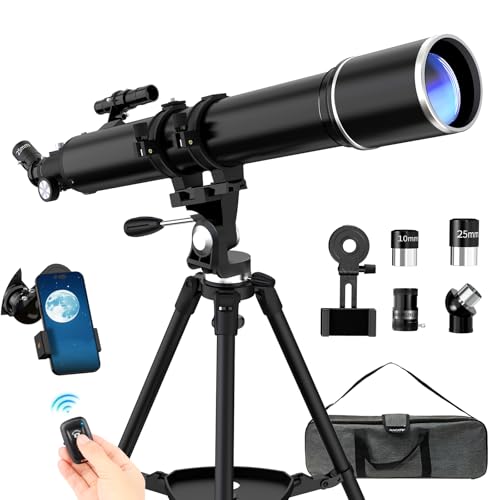
The FAMIROSA Telescope for Adults High Powered is a serious piece of equipment designed to bring the cosmos a little closer. With its 90mm aperture and 900mm focal length, this refractor telescope gathers a significant amount of light, which is the key to bright, clear views. The fully coated optics glass lens not only enhances image quality but also provides essential protection for your eyes during extended viewing sessions.
Whether your target is the craters of the moon, the rings of Saturn, or distant star clusters, the superior optics form the foundation for a rewarding astronomy experience.
Versatility in magnification is a standout feature. The telescope comes with two eyepieces (H10mm and H25mm) and a 3X Barlow lens. This combination offers a practical magnification range from 36X to 270X.
The lower power is perfect for sweeping across wide star fields or observing the entire moon, while the higher magnifications allow for closer inspection of planetary details. It gives you the tools to adapt your view to different celestial objects without needing a huge collection of accessories right away.
Sharing what you see is straightforward. The included phone adapter makes this an astrophotography telescope in its most accessible form.
NACATIN Telescope 90mm EQ Refractor Telescope for Adults & Professionals, High Powered Portable Telescope with Phone Adapter for Astrophotography, Easy Setup Travel Telescope to See Moon,Planet
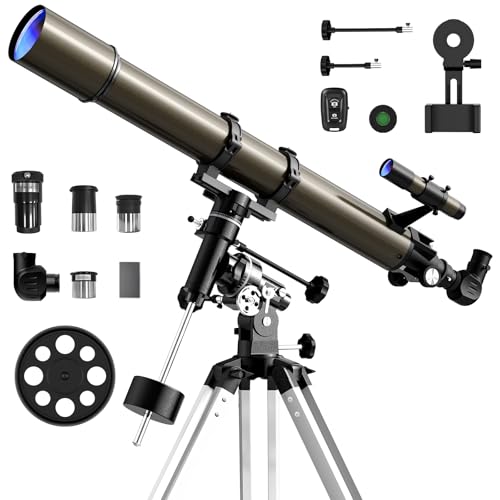
The NACATIN 90mm EQ Refractor Telescope is designed for adults and aspiring professionals who want a serious, yet portable, instrument for celestial viewing. Its core performance comes from the 90mm aperture and 1000mm focal length. The larger aperture pulls in more light, meaning you get brighter, clearer images of faint objects. The long focal length provides the high magnification needed to see fine details, like the textures on the Moon or the distinct gap in Saturn’s rings.
With the included set of eyepieces and a 3x Barlow lens, you have a flexible magnification range from 50X up to 500X, letting you frame wide lunar landscapes or zoom in for a closer look at planetary features.
What truly sets this telescope apart is its professional-grade equatorial mount. This isn’t just a point-and-look tripod; it’s a system designed for tracking.
Once you’ve done a simple polar alignment, the Earth’s rotation is easily counteracted by turning just one slow-motion control knob. This means you can keep Jupiter centered in your eyepiece for an extended observation session without constantly nudging the telescope.
Bushnell Refractor 600x50mm Telescope, Deep Space Viewing Telescope 181561

The Bushnell Refractor 600x50mm Telescope, Deep Space Viewing Telescope 181561 is designed for anyone curious about whats up in the night sky. This is a refractor telescope, which means it uses lenses to gather light. That design is known for being durable and relatively low-maintenance, making it a solid choice for beginners and casual stargazers.
Its main optical tube is 50mm in diameter. This aperture is the key to how much you can see.
It collects enough light to bring in clear views of the Moon’s craters, the rings of Saturn, and the moons of Jupiter. The 600mm focal length provides good magnification for getting a closer look at these celestial objects. While deep space viewing like distant galaxies will appear as faint smudges, this scope does open a window to the broader cosmos beyond our solar system.
You’ll find the setup to be straightforward.
The telescope comes mounted on an altazimuth tripod, which moves up-down and left-right for intuitive pointing. This is simpler than an equatorial mount, so you can be ready to observe quickly. The package includes different eyepieces to change your magnification level. Starting with a lower power eyepiece is often best, as it gives you a wider field of view and is easier to focus, making it simpler to find what your looking for.
Considering its size, this telescope is quite portable.
Slokey Discover The World Telescope for Astronomy for Adult Beginners – Professional, Portable and Powerful 20x-250x – Easy to Mount and Use – Astronomical Telescope for Moon, Planets and Stargazing

The Slokey Discover The World 50080 Telescope is designed for adults taking there first steps in astronomy. It balances professional-level optics with a setup process that’s genuinely straightforward, so you can spend less time fiddling and more time observing. This portable package gives you the power to view celestial wonders, from the craters of the Moon to the rings of Saturn, with remarkable clarity. Its core advantage is flexible optics.
The telescope comes with three eyepieces (25mm, 10mm, and 6mm) and a 3x Barlow lens. This combination lets you choose from five different magnifications: 20x, 50x, 83x, 150x, and 250x. You can start with a wide, stable view of the Moon at lower power, then switch components to zoom in on planetary details. This adaptability means the telescope grows with your skills, suiting various viewing conditions and targets. Optical quality is where this instrument truly shines.
The 3.1-inch aperture gathers a significant amount of light, while the 19-inch focal length provides sharp, high-resolution images. This specifcation is key for viewing not just bright planets, but also for beginning deep-sky observations of star clusters and nebulae. The images you see will be bright, precise, and detailed, making each viewing session rewarding. Stability is crucial for astronomy, and the Slokey 50080 adresses this with its sturdy stainless steel tripod.
National Geographic Sky View 70mm Refractor Telescope with Panhandle Mount for Adults and Kids
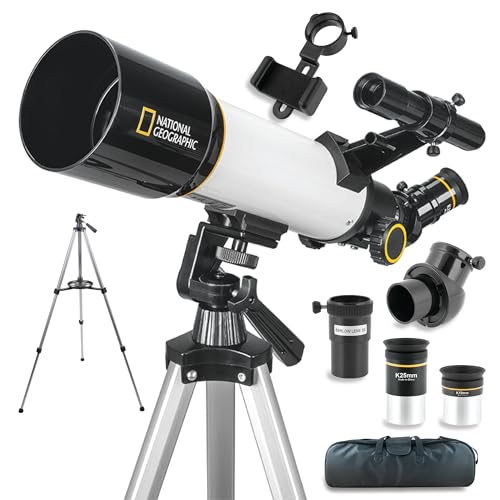
The National Geographic Sky View 70mm Refractor Telescope with Panhandle Mount is designed to bring the night sky closer for both begining stargazers and those looking for a straightforward, capable instrument. Its 70mm aperture is the key to its versatility, gathering enough light to provide clear views of lunar craters, the rings of Saturn, Jupiter’s major moons, and brighter deep-sky wonders like the Orion Nebula.
This makes it a solid choice for anyone wanting to move past simple binoculars.
You get multiple ways to zoom in on these celestial targets. The telescope’s 400mm focal length works with the included eyepieces and a 3x Barlow lens to offer four different magnification levels: 16x, 40x, 48x, and 120x. This range lets you start with a wide, easy-to-find view and then increase the power for a more detailed look.
Swapping between the eyepieces and lens is simple, encouraging you to experiment and see what works best for each object you’re observing.
A particularly engaging feature is the smartphone adapter. This little tool clips onto an eyepiece, allowing you to capture pictures of the Moon or snap a photo to share with friends. It’s a fun and accessible introduction to astrophotography without needing complex equipment.
Telescope for Adults High Powered, 80mm Aperture 600mm Telescopes for Astronomy Adults&Kids&Beginners, Portable Travel Refractor Telescope with Tripod&Phone Adapter&Bag for Ground&Moon Viewing, Pink
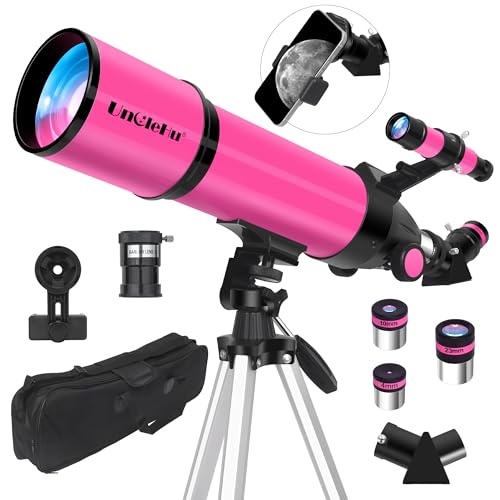
The Telescope for Adults High Powered, 80mm Aperture 600mm Refractor is designed to make astronomy accessible and enjoyable for everyone. Its standout pink finish offers a unique and stylish choice that sets it apart from typical gear, making it a fun option for individuals or families who want to stand out.
At its core, this telescope is built for clear, bright views.
The 80mm aperture objective lens is fully multi-coated, which significantly improves light gathering and image clarity. This means you get sharp, detailed observations of the Moon’s craters, as well as distant terrestrial objects like mountains or wildlife. It’s a capable instrument for adults and a fascinating educational tool for kids and beginners just starting there journey.
Flexibility in viewing is a key strength.
With the included 23mm, 10mm, and 4mm eyepieces, plus a 3x Barlow lens, you can achieve magnifications from 26x up to 450x. You can start with a wide, manageable view to find your target, then zoom in for a closer look. Switching between eyepieces is straightforward, allowing you to adapt to different viewing conditions and subjects easily.
The package includes a comprehensive set of accessories designed for practical use.
MaxUSee Lunar Telescope for Kids and Astronomy Beginners, Refractor Telescope with Finder Scope and 3 Eyepieces, Travel Telescope with Compact HD Binoculars for Moon Viewing Bird Watching Sightseeing

The MaxUSee Lunar Telescope for Kids and Astronomy Beginners is a versatile optical kit designed to introduce you to the skies and the world around you. It combines a capable refractor telescope with a pair of compact, high-definition binoculars, making it a great starting point for curious minds of all ages.
At its core is a 50mm aperture refractor telescope.
The high-quality optics are designed to gather light effectively, providing brighter and clearer views of celestial targets like the Moon’s craters. You get three interchangeable eyepieces (H20mm, H12.5mm, and SR4mm) along with a 1.5x erecting eyepiece. This combination allows for a range of magnifications from 18x up to 135x, so you can adjust the view to suit different objects.
A 5×24 finder scope is attached to the main telescope, which is a huge help for locating things in the night sky much faster than with the main tube alone.
The included compact HD binoculars are a practical addition. With 8x magnification and a 21mm objective lens, they are built for daytime adventures. The full multi-coated lenses and Bak4 prism work together to offer a sharp, clear image.
Best Telescope For Viewing Planets And Galaxies Buying Guide
To view planets and galaxies, prioritize both magnification and light gathering. But which specs actually matter for crisp Saturn rings or faint nebulae? This guide cuts through the jargon to help you choose the right tool. The best telescope for viewing planets and galaxies balances power with stability, and it starts with understanding a few key factors.
Aperture: Your Light Bucket
Think of aperture as the telescope’s main light-collecting lens or mirror. A wider aperture gathers more light, revealing fainter details in galaxies and sharper views of planets. A common beginner mistake is chasing high magnification with a tiny scope; the image becomes dim and fuzzy. For deep-sky objects, a 6-inch or larger aperture is a great starting point for pulling in enough light.
Mount Stability is Everything
Have you ever tried to look through binoculars while walking? A wobbly mount makes viewing frustrating. A sturdy equatorial or alt-azimuth mount is non-negotiable, especially at high magnifications where even a breeze can jiggle Jupiter out of view. A good mount feels solid, tracks smoothly, and holds your scope perfectly still so you can actually enjoy the view.
Optical Design Choices
Refractors, reflectors, compound telescopes—what’s the difference? For planets, a long-focal-length refractor offers high contrast and sharpness. For fainter galaxies, a reflector’s larger aperture for the price is often the winner. Compound scopes, like Schmidt-Cassegrains, offer a versatile middle-ground in a portable package. Consider what you’ll look at most.
Eyepieces & Useful Magnification
The telescope’s main tube is only half the system. Quality eyepieces are crucial. More magnification isn’t always better; atmospheric conditions often limit useful power to about 50x per inch of aperture. Start with a couple good-quality eyepieces, like a 25mm for wide views and a 10mm for planets, to give you flexibility without breaking the bank.
Frequently Asked Questions About Best Telescope For Viewing Planets And Galaxies
What type of telescope is best for planets and galaxies?
For planets, a telescope with a long focal length is great for high magnification. For faint galaxies, you want a telescope with a large aperture to gather more light. A Schmidt-Cassegrain or a large Dobsonian reflector are both excellent choices that balance these needs.
Is aperture or magnification more important?
Aperture is almost always more important. A bigger aperture lets in more light, which makes distant galaxies and nebulae appear brighter and clearer. High magnification is useless if teh image is too dim. Start with good aperture, then get quality eyepieces for magnification.
Can I use a telescope I buy for planets to also see galaxies?
Absolutely, yes. Most telescopes can view both. The key is managing your expectations. Planets like Jupiter and Saturn are bright and detailed. Galaxies are much fainter and will appear as fuzzy gray patches. But seeing that faint light with your own eyes is incredible.
Do I need a computerized “GoTo” mount?
Not necessarily. A GoTo mount finds objects for you, which is helpful in light-polluted areas. But a manual mount is simpler, cheaper, and many astronomers feel it helps you learn the sky better. It’s a personal preference based on your budget and patience.
Where is the best place to use my telescope?
The best place is always away from city lights. Your backyard is a fine start, but to really see galaxies, you need dark skies. A local park or a rural area makes a huge difference. Even driving a little ways out of town helps alot.
What can I realistically expect to see?
You’ll see Jupiter’s bands and its moons, Saturn’s rings, and craters on our Moon. For galaxies, you’ll see the Andromeda Galaxy as a fuzzy oval and the Orion Nebula’s cloudy core. You won’t see Hubble-like color photos, but the real-time view is special.
How much should I spend for a good starter scope?
A decent starter telescope for both planets and deep-sky objects often costs between $300 and $600. In this range, you can find reflectors with good aperture. Avoid very cheap department store telescopes, as thay often lead to frustration.
One Last Look
We hope this guide has helped clear up the sky for you. Choosing your first—or next—telescope is a big step. It’s about finding the right tool to match your curiosity. Remember, the best gear is the gear you’ll actually use. So consider where you’ll store it and how often you’ll take it outside. A simpler scope used regularly beats a complex one that gathers dust.
Start with some easy targets like the Moon or Saturn’s rings. Your confidence will grow with each viewing session. With patience and a little practice, the cosmos begins to feel closer. Whatever you decide, the journey to find the best telescope for viewing planets and galaxies is a personal one. Clear skies and happy viewing from here on out.