See unstained specimens on a dark background clearly. It’s like viewing stars against the night sky, but for biology. A darkfield microscope makes this possible, illuminating your sample from the sides so it glows against a dark void. You don’t need stains, which can alter or even kill delicate, living subjects.
It opens a window into a world of incredible detail you’d otherwise miss. Whether your a hobbyist peering at pond water or a student studying cells, the effect is genuinely stunning. This review will explore how this technique works and if a specific model is the right tool to bring this hidden world into focus for you.
Product Comparison Table: 9 Best Darkfield Microscope
| Image | Why We Like This Product | Editor’s Rating | |
 |
[Darkfield Blood Model] Lab Darkfield & Brightfield Vabiooth Trinocular…
|
9.5 |
Read Review |
 |
AmScope – 40X-2000X Trinocular Compound Darkfield Microscope with Oil…
|
9.3 |
Read Review |
 |
AmScope T490B-DK Compound Trinocular Microscope, WF10x and WF20x Eyepieces,…
|
9.1 |
Read Review |
 |
AmScope T490A-PCT Compound Trinocular Microscope with Phase-Contrast Turret, WF10x…
|
8.8 |
Read Review |
 |
AmScope T580B-DK 40X-2000X Professional Darkfield Research Biological Compound Microscope
|
8.6 |
Read Review |
 |
AmScope B490A-LED Compound Binocular Microscope, WF10x and WF16x Eyepieces,…
|
8.4 |
Read Review |
 |
Woehrsh Trinocular Microscope 40X-5000X Magnification Laboratory Grade with Dual…
|
8.2 |
Read Review |
 |
AmScope B490B-DK Compound Binocular Microscope, WF10x and WF20x Eyepieces,…
|
7.9 |
Read Review |
 |
AmScope DK-DRY100 Dry Darkfield Condenser For Compound Microscopes
|
7.7 |
Read Review |
Quick Review For Top 9 Darkfield Microscope
[Darkfield Blood Model] Lab Darkfield & Brightfield Vabiooth Trinocular Compound Microscope 40X-2500X Magnification with 7" Monitor 5MP E-Eyepiece, Adjustable Mechanical Stage, LED Illumination
![[Darkfield Blood Model] Lab Darkfield & Brightfield Vabiooth Trinocular Compound Microscope 40X-2500X Magnification with 7" Monitor 5MP E-Eyepiece, Adjustable Mechanical Stage, LED Illumination](https://m.media-amazon.com/images/I/51h4Ixj-c1L._SL500_.jpg)
The Vabiooth Darkfield Blood Model Trinocular Compound Microscope is a specialized instrument designed for serious amateur researchers and microbiological enthusiasts. Its core capability lies in its dual illumination system, offering both standard brightfield and the more advanced darkfield observation.
This darkfield function is specifically configured for researching live blood samples, allowing you to see cells and other structures in stark, illuminated detail against a dark background without staining, which is crucial for viewing specimens in their natural state. You’ll appreciate the multiple viewing options. It comes with three widefield glass eyepieces (10X, 16X, 25X) set at a comfortable 30-degree angle to help reduce neck strain during long sessions.
The trinocular head also integrates a 5MP electronic eyepiece connected to a built-in 7-inch LCD screen that rotates a full 360 degrees. This means you can view a large, clear image directly on the microscopes own display, making it easier to share your findings with others or simply work in a more relaxed posture. The four achromatic objectives (4x, 10x, 40xs, 100xs oil) provide a magnification range from 40X up to 2500X, giving you the flexibility to zoom in on fine details.
AmScope – 40X-2000X Trinocular Compound Darkfield Microscope with Oil Condenser – T490B-DKO

The AmScope T490B-DKO is a professional-grade trinocular compound microscope designed for serious observation. It bridges the gap between advanced educational use and demanding clinical or veterinary applications. If you need a reliable instrument for detailed specimen study, this model offers a robust set of features to support your work.
Its magnification range is a key starting point. With 40X to 2000X power, you can examine a wide variety of samples.
This includes larger structures like hair follicles down to finer details of cells and bacteria. The microscope comes with both 10X and 20X widefield eyepieces, which combine with the objectives to give you eight distinct magnification settings. This flexibility means you don’t have to switch microscopes when you switch tasks.
The build quality and optical design are tailored for precision and comfort.
The Siedentopf trinocular head allows for smooth interpupillary adjustment without changing the focus, which is a real time-saver. You’ll find the coaxial coarse and fine focusing knobs are ergonomically placed, making it easy to achieve a sharp image without strain.
AmScope T490B-DK Compound Trinocular Microscope, WF10x and WF20x Eyepieces, 40X-2000X Magnification, Brightfield/Darkfield, Halogen Illumination, Abbe Condenser, Double-Layer Mechanical Stage, Sliding Head, High-Resolution Optics

The AmScope T490B-DK Compound Trinocular Microscope is a professional-grade instrument designed for demanding biological observation and educational instruction. It bridges the gap between advanced student work and professional research, offering a robust set of features that provide clarity, durability, and flexibility in the lab. This microscope is a trinocular compound system, meaning it has two eyepieces for you to look through and a third, vertical port for mounting a camera.
This setup is perfect for when you need to document your findings or share a live view with others. The viewing head itself is a Siedentopf design, which adjusts smoothly for different eye widths (55-75mm) and rotates a full 360 degrees. Its fixed 30-degree angle is a key ergonomic feature, significantly reducing neck and eye strain during long sessions. Magnification is versatile, ranging from 40X to 2000X.
You get two pairs of widefield eyepieces (10x and 20x) and a quadruple nosepiece with achromatic objectives: 4x, 10x, 40x (spring-loaded), and a crucial 100x oil-immersion lens (also spring-loaded). These precision-ground glass lenses are corrected for color, giving you a true, high-resolution image. The nosepiece is forward-facing, which makes switching objectives intuitive and quick. Illumination is a highlight. A halogen light source with a rheostat dial gives you bright, adjustable light.
AmScope T490A-PCT Compound Trinocular Microscope with Phase-Contrast Turret, WF10x and WF16x Eyepieces, 40X-1600X Magnification, Brightfield/Darkfield, Halogen Illumination, Abbe Condenser, Double-Layer Mechanical Stage, Sliding Head, High-Resolution Optics
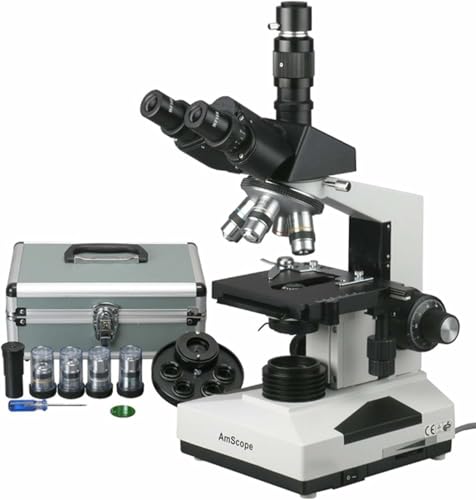
The AmScope T490A-PCT Compound Trinocular Microscope is a professional-grade instrument designed for demanding biological research and advanced educational settings. It combines high-resolution optics with versatile illumination techniques to reveal exceptional detail in your specimens. This microscope’s core strength is its optical versatility. It offers three critical viewing modes: brightfield, darkfield, and phase-contrast.
Brightfield is your standard view, while darkfield illuminates specimens against a dark background, great for transparent samples. The phase-contrast turret is a standout feature, allowing you to view live, unstained cells with remarkable clarity without harming them—this is crucial for microbiology or live cell culture work. You control all this with a powerful halogen light source and a precise Abbe condenser, which together give you incredible command over illumination and contrast.
The trinocular head is built for both comfort and functionality. The Siedentopf design makes interpupillary adjustment quick and maintains focus. Its fixed 30-degree angle significantly reduces neck strain during long sessions. You can also rotate the head a full 360 degrees, making it easy to share views with a colleague. The third port is for mounting a camera, enabling you to capture high-quality images and video for documentation or analysis.
AmScope T580B-DK 40X-2000X Professional Darkfield Research Biological Compound Microscope
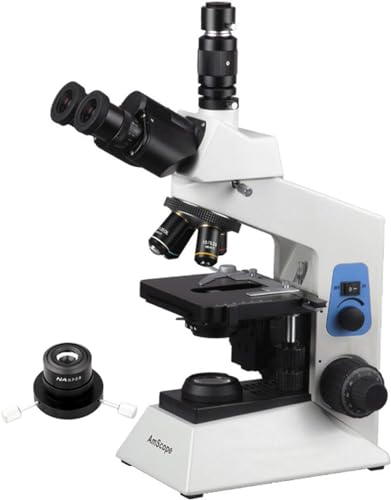
The AmScope T580B-DK 40X-2000X Professional Darkfield Research Biological Compound Microscope is a serious instrument designed for demanding applications in labs, clinics, and advanced educational settings. It combines high magnification with versatile viewing and illumination options to handle a wide range of specimens.
At its core, this is a trinocular compound microscope, meaning it has two eyepieces for you to look through and a third, vertical port for attaching a camera.
This setup is essential for documentation and sharing images without interrupting direct observation. The viewing head itself is a Siedentopf design, which maintains focus while you adjust the width between the eyepieces (from 55 to 75mm) to match your eyes.
It’s fixed at a comfortable 30-degree angle to reduce strain during long sessions and rotates a full 360 degrees, making it easy to share the view with a colleague without moving the whole microscope.
You’ll get two pairs of high-quality eyepieces: 10x and 20x widefield. These, combined with the four objective lenses on the forward-facing nosepiece, give you a magnification range from 40x up to 2000x. The objectives are DIN achromatic lenses made from precision-ground optical glass.
AmScope B490A-LED Compound Binocular Microscope, WF10x and WF16x Eyepieces, 40X-1600X Magnification, Brightfield/Darkfield (BF/DF), LED Illumination, Abbe Condenser, Double-Layer Mechanical Stage, Sliding Head, High-Resolution Optics, Anti-Mold

The AmScope B490A-LED Compound Binocular Microscope is a serious instrument designed for detailed biological observation and demanding educational environments. It offers a broad magnification range from 40X up to 1600X, giving you the flexibility to examine everything from whole insect specimens down to cellular details.
The core of this microscope is it’s high-resolution optics, which are engineered for clarity and accurate color reproduction in the images you see.
You’ll appreciate the binocular viewing head, which is much more comfortable for extended use than a monocular style. It comes with two pairs of eyepieces—10x and 16x widefield—to give you different viewing options.
The head slides to adjust for different users eye spacing, and it rotates a full 360 degrees, making it easy to share what your seeing with others without moving the whole microscope. Its fixed tilt also helps reduce neck strain during long sessions.
For looking at your slides, the microscope has four objective lenses mounted on a forward-facing nosepiece: 4x, 10x, 40x, and a 100x oil immersion lens.
Woehrsh Trinocular Microscope 40X-5000X Magnification Laboratory Grade with Dual Mechanical Stage and HD USB Camera Microscopes for Adults(Adult Trinocular Microscope with Electronic Eyepiece)

The Woehrsh Trinocular Microscope 40X-5000X with HD USB Camera is a serious tool designed for detailed inspection and learning. It bridges the gap between professional laboratory equipment and accessible home or educational use, giving you a robust platform for a wide range of applications.
At its core, this microscope is built for clarity and comfort. It features wide-angle WF10x and WF25x eyepieces, which means you get a broader, more comfortable view of your specimen.
The adjustable isometric design and refractive index settings mean you don’t have to strain or squint; it adapts to your eyes. The trinocular head allows you to use both eyepieces for traditional viewing or attach the included HD USB camera to capture images and video directly on your computer—perfect for documentation or sharing your findings.
The optical performance is where it truly stands out. It utilizes a real 195 achromatic objective lens within an infinity optical system.
This technical design minimizes color distortion (effectively eliminating red, blue, and green fringing) and maximizes resolution for a remarkably clear image. Combined with the various eyepieces and 2x magnifying lenses, you achieve a true magnification range from 40X to 5000X, suitable for viewing everything from plant cells to intricate insect parts.
Operation is smooth and precise thanks to its “8 core” design features.
AmScope B490B-DK Compound Binocular Microscope, WF10x and WF20x Eyepieces, 40X-2000X Magnification, Brightfield/Darkfield (BF/DF), Halogen Illumination, Abbe Condenser, Double-Layer Mechanical Stage, Sliding Head, High-Resolution Optics, Anti-Mold

The AmScope B490B-DK Compound Binocular Microscope is a professional-grade instrument designed for serious biological study and advanced educational settings. It bridges the gap between standard classroom microscopes and high-end laboratory equipment, offering a robust feature set that supports detailed observation from 40X up to 2000X magnification.
You’ll appreciate the binocular viewing head, which comes with both 10x and 20x widefield eyepieces.
The sliding head adjusts easily to fit your eye spacing, and its fixed 30-degree tilt significantly reduces neck and eye strain during long sessions. The entire head rotates a full 360 degrees, making it simple to share veiws with a colleague or instructor without moving the whole microscope.
Image quality is a clear priority here. The forward-facing nosepiece holds four DIN achromatic objectives: 4x, 10x, 40x (spring-loaded), and a 100x oil-immersion lens (also spring-loaded).
These precision-ground glass lenses are color-corrected for accurate representation of your specimen. A key feature for long-term reliability is the anti-mold treatment on optical surfaces, which protects your investment if you’re working in a humid environment.
The illumination system is versatile. It uses a bright, adjustable halogen light with a rheostat for fine control over intensity.
AmScope DK-DRY100 Dry Darkfield Condenser For Compound Microscopes

The AmScope DK-DRY100 Dry Darkfield Condenser is a specialized optical component designed to enhance the capabilities of your standard compound microscope.
If you work with transparent or low-contrast samples that are difficult to see under normal brightfield lighting, this condenser offers a different viewing method that can reveal details otherwise invisible.
Darkfield microscopy works by blocking the central light that would normally pass directly through the sample and into the objective lens. Instead, the DK-DRY100 uses a clever design to illuminate the sample with a hollow cone of light.
Only light that is scattered by the specimen enters the objective. This results in a dramatic visual effect: a bright, glowing image of the sample against a dark, black background. It’s exceptionally useful for observing live microorganisms like bacteria or plankton, tiny aquatic organisms, and certain types of cells and tissues without the need for staining, which can kill or alter them.
A key feature of this condenser is its compatibility.
Darkfield Microscope Buying Guide
Darkfield microscopy is a technique for viewing unstained, transparent specimens. It works by illuminating the sample with a hollow cone of light, making details glow brightly against a dark background. This guide helps you choose the right instrument for your needs, whether you’re a hobbyist, student, or professional.
Illumination System Type
This is the core of the technique. Do you need a dedicated darkfield microscope, or can you use a standard compound model? Many standard microscopes can be adapted with special condenser inserts or patch stops, which is a cost-effective option. However, for frequent, high-quality use, a dedicated instrument with a built-in, centerable darkfield condenser provides superior, consistent results and saves you the hassle of switching parts.
Magnification & Objective Compatibility
Not all microscope objectives work well with darkfield. Standard high-power objectives (like 100x oil immersion) often have a numerical aperture too high for proper darkfield. Look for objectives specifically labeled as “darkfield” or with a lower NA. Consider the magnification range you’ll use most. Lower powers (4x, 10x) are great for larger specimens, while higher powers (40x, 60x) reveal finer details. Ensure your chosen system supports the magnifications you need.
Build Quality and Stability
A darkfield image is sensitive to vibration. A flimsy microscope stand can turn a crisp, glowing specimen into a shaky, frustrating blur. Look for a solid, heavy base and a robust focusing mechanism. Smooth, precise focus is non-negotiable for capturing those stunning high-contrast images. Metal construction is generally prefered over plastic for durability, especially if the microscope will be used regularly or in a classroom setting.
Light Source Brightness
Because the technique blocks most central light, a bright illumination source is crucial. LED lights are excellent—they’re bright, cool-running, and long-lasting. Halogen bulbs are also bright but generate more heat. Consider adjustability: can you control the intensity? A dimmable light source allows you to perfect the contrast for different specimens, preventing a washed-out image and reducing eye strain during long observation sessions.
Frequently Asked Questions About Darkfield Microscopes
What is darkfield microscopy?
It’s a special lighting technique. A darkfield microscope uses a special condenser to block direct light. Instead, it scatters light sideways onto your sample. This makes transparent or pale specimens, like live bacteria, appear bright against a dark background. It’s great for seeing details you’d otherwise miss.
What can I see with a darkfield microscope?
You can view things that are hard to see with a regular brightfield microscope. This includes live microorganisms in pond water, like algae and tiny plankton. It’s also used for looking at cells in bodily fluids, fibers, and minerals. It’s perfect for observing things that are nearly see-through.
Can I convert my regular microscope to darkfield?
Often, yes! Many compound microscopes can be upgraded. You usually need to buy a special darkfield condenser that fits your microscope’s stage. Some microscopes even have a condenser with a built-in darkfield setting. You should check your microscope model to see if it’s compatible.
Is it hard to use a darkfield microscope?
It’s a bit different but not too difficult. The main trick is setting up teh lighting correctly. You need to center the condenser and adjust its height properly. Once you get the hang of it, it’s pretty straightforward. The results are often worth the little bit of extra setup.
What should I look for when buying one?
First, consider what you want to look at. For most hobbyists, a standard compound microscope with a darkfield kit is a good start. Check the magnification range—you’ll want objectives suited for darkfield. Also, look for a sturdy mechanical stage to help move slides precisely. Good lighting is key, so a bright LED light source is a great feature.
Are thay much more expensive than regular microscopes?
Not necessarily. A dedicated darkfield microscope can cost more, but conversion kits are affordable. If you’re buying new, expect to pay a bit of a premium for the specialized condenser and lighting. It’s best to compare models and see what fits your budget and needs.
Conclusion
A proper darkfield setup is built on these specialized components working in harmony. You need teh right condenser with its opaque stop to create that hollow cone of light. High-quality, dedicated objectives are crucial for capturing the scattered light without internal glare. Even your light source and sample slides play a big part. When everything aligns, the effect is stunning, revealing a hidden world in brilliant detail against a dark background.
This technique opens doors in many fields, from biology to materials science. Investing in a good darkfield microscope setup means you’re choosing to see what ordinary brightfield microscopy leaves in the shadows. It’s a powerful tool for anyone who needs to examine transparent or low-contrast specimens. With the correct foundation, your observations become clearer and far more informative, giving you a completly new perspective on your samples.