The critical component defining your telescope’s view quality. It’s not the fancy mount or the brand name, it’s the telescope lens. That piece of glass is your window to the cosmos, and its quality makes all the difference between a fuzzy blob and a sharp, detailed planet. A great one brings the rings of Saturn into crisp view, a poor one leaves you squinting at a bright smudge.
Choosing the right lens can feel overwhelming, with so many specs and options. But don’t worry, we’re here to help you cut through the noise. This review will break down what truly matters for your stargazing, so you can invest in views that will take your breath away night after night.
Product Comparison Table: 9 Best Telescope Lens
| Image | Why We Like This Product | Editor’s Rating | |
 |
SVBONY SV135 Zoom Eyepiece, Zoom 7 to 21mm 1.25…
|
9.6 |
Read Review |
 |
SVBONY SV135 1.25” Zoom Eyepiece, Zoom 7 to 21mm…
|
9.4 |
Read Review |
 |
Celestron – Zoom Eyepiece for Telescope – Versatile 8mm-24mm…
|
9.2 |
Read Review |
 |
SVBONY Telescope Eyepiece, 68 Degree Ultra Wide Angle Eyepiece…
|
9.0 |
Read Review |
 |
SVBONY Telescope Eyepiece 40mm 1.25 inches Plossl Lens Fully…
|
8.8 |
Read Review |
 |
Astromania 4mm 1.25 Inch Plossl Telescope Eyepiece – Fully…
|
8.5 |
Read Review |
 |
SVBONY Eyepieces 4mm Telescopes Lens Wide Angle 62 Degree…
|
8.3 |
Read Review |
 |
SVBONY 4mm 10mm 23mm Telescope Eyepieces Lens Fully Coated…
|
8.1 |
Read Review |
 |
Starboosa Complete Telescope Eyepiece Set – Multi-Coated Optics -…
|
7.9 |
Read Review |
Quick Review For Top 9 Telescope Lens
SVBONY SV135 Zoom Eyepiece, Zoom 7 to 21mm 1.25 inch Telescope Eyepiece, 6 Element 4 Group Telescope Accessories for Astronomic Telescopes Visual
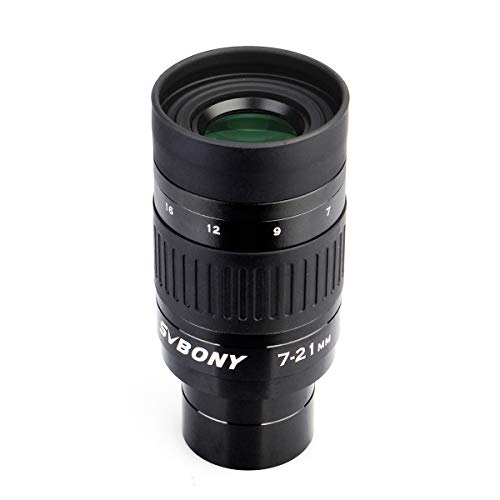
The SVBONY SV135 Zoom Eyepiece is a versatile 1.25-inch telescope accessory designed to simplify your observing sessions. Instead of fumbling with multiple individual eyepieces, this single unit offers an adjustable focal length that smoothly zooms from 7mm to 21mm.
That range is equivelent to carrying several fixed eyepieces, allowing you to quickly change magnification to suit your target, from wide-field views to closer planetary details.
One of its standout features is the generous 18mm to 16.3mm of eye relief, which remains comfortable even as you zoom. This is particularly beneficial if you wear eyeglasses, as you can observe without straining or removing them.
The rubber eye cup helps block stray light and adds to the comfort, making longer sessions more enjoyable. Whether your observing landscapes, the Moon’s craters, or distant planets, the comfortable viewing position is a significant advantage.
Optical quality is where the SV135 truly aims to impress. It uses a premium 6-element lens system arranged in 4 groups, which is more complex than standard designs.
SVBONY SV135 1.25” Zoom Eyepiece, Zoom 7 to 21mm Telescope Eyepiece 5 Element 3 Group, Telescope Accessories for Astronomic Telescopes Visual Planetary Nebula

The SVBONY SV135 1.25” Zoom Eyepiece is designed to simplify your stargazing sessions. If you’ve ever found yourself fumbling with multiple eyepieces in the dark, this zoom model offers a streamlined solution. It covers a range from 7mm to 21mm, letting you adjust magnification on the fly. This means you can start with a wider view to locate an object and then zoom in for a closer look, all without changing a single piece.
It’s versatile enough for observing the craters of the Moon, the rings of Saturn, distant star clusters, and faint nebulae. One eyepiece really can handle a lot of your observing needs.
Optical quality is a key focus here. The SV135 uses a 5-element lens system arranged in 3 groups. This design, crafted from high-index glass, works to reduce optical aberrations. The result is views that are sharp and have good contrast.
You can expect bright images with colors that feel true to life, which is especially important when trying to discern subtle details on a planet or within a nebula. The field of view changes as you zoom, ranging from 36 degrees at the higher magnification to a more expansive 52 degrees at the lower end. This gives you flexibility in how much sky you see at once.
Comfort during long nights at the telescope is crucial.
Celestron – Zoom Eyepiece for Telescope – Versatile 8mm-24mm Zoom for Low Power and High Power Viewing – Works with Any Telescope That Accepts 1.25" Eyepieces

The Celestron Zoom Eyepiece for Telescope is a versatile optical tool designed to simplify and enhance your viewing experience. Instead of managing a case full of single-power eyepieces, this single unit offers a continuous zoom range from 8mm to 24mm.
This means you can quickly adjust your telescope’s magnification to find the perfect view for any target, from sweeping star clusters to scrutinizing the moon’s craters, all without fumbling in the dark.
One of the primary advantages of this eyepiece is it’s flexibility. You are no longer locked into a fixed magnification. If atmospheric conditions are turbulent, you can easily zoom out to a lower power for a steadier, wider view.
When the air settles, you can zoom in for more detail on a planet. This adaptability makes it an excellent choice for both beginners learning the ropes and experienced observers who appreciate quick adjustments. It effectively condenses the need for several fixed focal length eyepieces into one convinient package.
Compatibility is straightforward. This zoom eyepiece works with any telescope, spotting scope, or binocular adapter that accepts the standard 1.25-inch eyepiece barrel.
SVBONY Telescope Eyepiece, 68 Degree Ultra Wide Angle Eyepiece 6mm, High Definition Fully Coated Telescope Accessories for Planetary Observation

The SVBONY 68 Degree Ultra Wide Angle 6mm Eyepiece is designed to enhance your planetary viewing sessions. Its core feature is the 68-degree apparent field of view. This wide angle design gives you a much broader picture through the telescope compared to standard eyepieces. It makes finding and centering targets, like a specific planet, quicker and easier. Once you have your target, the wide field helps immensely with tracking, as objects move slower across the wider view.
This means less frequent adjustments to your telescope’s position, letting you focus more on observation.
With a 6mm focal length, this eyepiece provides high magnification. This is ideal for when you want to zoom in on fine details. On a night of good seeing, the 6mm can reveal intricate lunar crater details, the division in Saturn’s rings, or cloud bands on Jupiter.
It’s a focal length dedicated to capturing those planetary features that make observing so rewarding.
The optical quality is supported by Fully Multi-Coated (FMC) lenses. This coating significantly improves light transmission, allowing more light to reach your eye for a brighter image. The interior of the eyepiece barrel is blackened to minimize stray light and internal reflections.
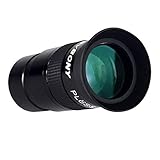
SVBONY Telescope Eyepiece 40mm 1.25 inches Plossl Lens Fully Multi Green Coated Metal 40 Degree Apparent Field 4 Element Telescope Accessory for Astronomy Telescope
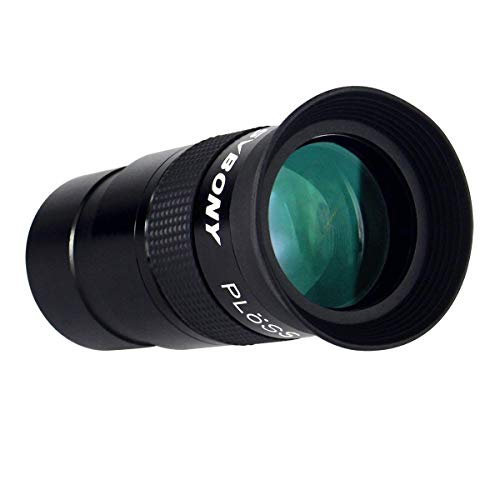
The SVBONY Telescope Eyepiece 40mm 1.25 inches Plossl Lens is designed for astronomers who want a wider, more immersive view of the night sky.
With its 40mm focal length and Plossl design, this eyepiece provides a lower magnification that reveals larger areas of space, making it an excellent choice for sweeping across star fields and locating objects.
Its key feature is the four-element optical design, which works to deliver a sharp, clear image across a generous 40-degree apparent field of view. This wide view is particularly well-suited for observing extended celestial objects.
You’ll find it perfect for taking in the entire lunar disc, resolving medium-sized star clusters like the Pleiades, and framing large, faint deep-sky targets such as the Orion Nebula or the Andromeda Galaxy. The wider field helps keep objects in view longer as the Earth rotates, which is a real benefit.
Every air-to-glass surface on the lens is fully multi-coated. This specialized green coating significantly reduces internal reflections and increases light transmission.
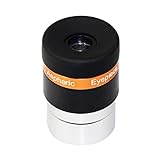
Astromania 4mm 1.25 Inch Plossl Telescope Eyepiece – Fully Multi Coated 4-Element Plossl Design Telescope Accessory with Standard 1.25 inch Filter Threaded for Visual Astronomy Observations

The Astromania 4mm 1.25 Inch Plossl Telescope Eyepiece is a specialized accessory designed to enhance your visual astronomy sessions. This eyepiece provides a high-magnification view, perfect for when you want to zoom in on the finer details of celestial objects. Its a tool for observers looking to get closer views of the planets, lunar craters, or tighter star clusters.
At its core is a premium 4-element Plossl optical design.
This four-glass construction is key for reducing optical aberrations, which means your getting images that are sharp and clear from the center all the way to the edge of the view. Every air-to-glass surface in this lens assembly is fully multi-coated. This advanced coating is crucial because it minimizes internal reflections and maximizes light transmission.
The result for you is brighter, more contrast-rich images with excellent color fidelity, even on faint deep-sky objects.
The eyepiece offers a 50-degree apparent field of view. While this is a standard field for Plossl designs, it provides a comfortable and immersive observing experience. Combined with the 4mm focal length, it delivers significant magnification on your telescope, letting you see fine planetary details or lunar features.
SVBONY Eyepieces 4mm Telescopes Lens Wide Angle 62 Degree Aspheric Eyepiece HD Fully Coated Telescope Accessory for 1.25 inches Astronomic Telescopes

SVBONY 4mm 62 Degree Aspheric Eyepiece
This SVBONY 4mm eyepiece is a specialized lens designed to give your telescope its highest possible magnification. With its very short 4mm focal length, it acts like a powerful magnifying glass for your scope, pulling distant objects into close-up view. This makes it a dedicated tool for planetary and lunar observation.
When conditions are right, you can look more closely at the craters and mountains on the moon, or try to discern the cloud bands on Jupiter and the rings of Saturn. It’s important to know that such high power is best used on nights with very steady, clear air, as it also magnifies atmospheric turbulence. The eyepiece features a standard 1.25-inch barrel, so it fits directly into most amateur astronomical telescopes without any need for adapters.
This universality means you can easily add this high-power option to your collection. Despite its powerful optics, the lens is surprisingly light, weighing only about 0.09 pounds. This is due to its aspheric design; compared to a traditional spherical lens, the aspheric element can be thinner and lighter while still correcting optical aberrations.
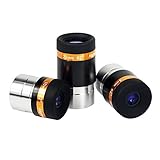
SVBONY 4mm 10mm 23mm Telescope Eyepieces Lens Fully Coated Lens Accessories Kit 62 Degree Wide Angle for 1.25 inches Astronomic Telescope

The SVBONY 4mm, 10mm, and 23mm Telescope Eyepieces Kit is designed to expand the capabilities of your 1.25-inch astronomical telescope. This set of three eyepieces gives you a range of magnifications to suit different kinds of celestial viewing, from the bright, intricate craters of the Moon to fainter deep-sky objects.
You get three specific focal lengths: 4mm, 10mm, and 23mm.
The 23mm eyepiece offers a wider, lower-power view, perfect for initially locating objects and observing larger star clusters. The 10mm provides a middle-ground magnification, while the 4mm delivers high power for scrutinizing fine details on bright targets like planets. Together, they cover a lot of observing needs without overwhelming you with choices.
A key feature of these eyepieces is the 62-degree wide-angle design.
This wider field of view makes it easier to find objects in the sky and provides a more immersive experience, especially when scanning star fields or looking at extended nebulae. You’ll spend less time struggling to center an object and more time actually enjoying the view.
The optical quality is a step up from basic eyepieces. They use aspherical lens elements, which are shaped to reduce common optical distortions like spherical aberration.
Starboosa Complete Telescope Eyepiece Set – Multi-Coated Optics – 1.25 inch Eyepiece Set with 4mm, 10mm, 20mm Lenses, 5X Barlow Lens, 2 Moon Filters, 2 Polarizing Filters

The Starboosa Complete Telescope Eyepiece Set is a comprehensive kit designed to expand what you can see with your telescope. If you’ve ever felt limited by the eyepieces that came with your scope, this set aims to give you the tools for a much wider range of observations, from sweeping starfields to detailed planetary views.
At its core are three multi-coated eyepieces: 4mm, 10mm, and 20mm focal lengths.
The 20mm gives you a wider, lower-power view perfect for hunting star clusters or nebulae. The 10mm offers a mid-range magnification, while the 4mm is for your highest-power, close-up looks at the moon and planets. The real game-changer is the included 5x Barlow lens. When you insert an eyepiece into it, it multiplies that eyepiece’s magnification by five.
This effectively turns your three eyepieces into six, giving you much more flexibility without needing to buy separate, high-power lenses which can be tricky to use.
This set also thoughtfully includes four filters to improve your viewing. The two moon filters are essential. The moon is incredibly bright through a telescope, and these filters cut down the glare and harsh light, letting you see craters and maria in much better contrast without eye strain.
Telescope Lens Buying Guide
Your telescope lens choice determines clarity and detail. It’s teh eye of your telescope, and picking the right one can mean the difference between a fuzzy blob and a sharp view of Saturn’s rings. This guide will help you understand the key factors so you can make a confident choice for your stargazing adventures.
Aperture: The Light Gatherer
Think of aperture as the lens’s light-collecting bucket. A larger aperture (measured in millimeters) captures more light. This means brighter, clearer images, especially for faint deep-sky objects like galaxies. More light also allows for higher useful magnification. It’s the most important spec for image brightness.
Focal Length & Magnification
The focal length of your telescope, combined with an eyepiece, determines magnification. A longer telescope focal length provides higher potential magnification for planets. But remember, maximum useful magnification is limited by aperture and atmospheric conditions. Too high, and the image gets dim and fuzzy. Start with lower power for wider, brighter views.
Lens Coatings & Optical Quality
Not all glass is created equal. Look for fully multi-coated lenses. These special coatings reduce internal reflections and glare, significantly improving contrast and color fidelity. You’ll see darker blacks in space and more detail on the lunar surface. It’s a sign of quality optics that makes a real difference.
Barrel Size & Compatibility
Check your telescope’s focuser. Most modern models use either 1.25-inch or 2-inch barrels. Ensure the lens you choose matches this size. Adapters exist, but it’s best to use the native size for a secure fit and optimal performance. A wobbly eyepiece ruins the view, so compatability is key.
Frequently Asked Questions About Telescope Lens
What’s the difference between an eyepiece and the main lens?
The main lens (or mirror) is in the telescope tube. It gathers light. The eyepiece is the smaller lens you look through. It magnifies the image the main lens collects. You need both to work together.
How do I know what magnification I’m getting?
Magnification isn’t fixed. You calculate it by dividing the telescope’s focal length by the eyepiece’s focal length. For example, a 1000mm telescope with a 20mm eyepiece gives you 50x power. A shorter eyepiece focal length means higher magnification.
Are more expensive lenses always better?
Not always. A very high-power eyepiece on a small telescope will show a dim, fuzzy image. It’s about matching the lens to your telescope’s capabilities. Sometimes a simpler, mid-range lens offers the best views for your specific setup.
What do the numbers on an eyepiece mean?
The main number is the focal length in millimeters (like 10mm or 25mm). A smaller number means more magnification. You might also see a measurement like “62°” which is the apparent field of view. A wider number gives a more immersive look at the sky.
Why are some eyepieces much wider than others?
Wider field eyepieces let you see a bigger slice of sky. This is great for star clusters or finding objects. They tend to be more expensive becuase the lens design is more complex. Narrower fields are common in basic eyepieces.
Can I use any brand of eyepiece with my telescope?
Mostly, yes. The critical factor is the barrel size. The two standard sizes are 1.25-inch and 2-inch. Check your telescope’s focuser to see which size it accepts. As long as the barrel fits, the brand usually doesn’t matter.
What does “eye relief” mean?
Eye relief is the distance your eye can be from the eyepiece and still see the whole view. Longer eye relief is more comfortable, especially if you wear glasses. Shorter eye relief means you have to press your eye right up to the lens.
How many eyepieces do I really need?
Start with two or three. A low-power one (like 25mm) for finding objects and wide views. A medium-power one (around 10mm) for general viewing. Maybe a high-power one (like 6mm) for planets on nights with steady air. That covers most situations.
Wrapping Things Up
The right glass makes all teh difference in your view. It’s the final piece that connects you to the cosmos. Think about what you most want to see. Is it the rings of Saturn, the craters on the Moon, or distant galaxies? Your choice should match those goals. A good lens feels like a natural extension of your telescope, not just an accessory. It brings those faint, far-away details into sharp, bright focus right before your eyes. Investing in quality here is investing in countless nights of wonder.
Remember, the best equipment is the stuff you’ll actually use. Start with one or two versatile options. Get comfortable with them. Learn how different magnifications change your perspective on the same target. Over time, you’ll know exactly when to swap in a specific telescope lens for the perfect look. This journey is about patience and practice. With the right tools, every clear night becomes an opportunity for a personal, stunning show. So, check your gear, look up, and enjoy the sky.