Your microscope’s objective is its most critical component. It’s the lens right near your sample, doing the heavy lifting to gather light and form that first, crucial image. Choosing the right objective microscope can make or break your work, whether your a student, hobbyist, or professional. It directly determines resolution, clarity, and how much detail you can actually see.
But with so many specs and types out there, picking one feels overwhelming. This review cuts through the jargon to help you understand what really matters. We’ll look at key features and performance so you can invest in an objective that truly elevates your viewing experience.
Product Comparison Table: 9 Best Objective Microscope
| Image | Why We Like This Product | Editor’s Rating | |
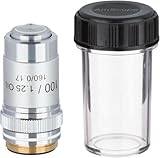 |
AmScope A100X 100X (Oil) Achromatic Microscope Objective
|
9.6 |
Read Review |
 |
AmScope A10X 10X Achromatic Microscope Objective
|
9.4 |
Read Review |
 |
AmScope A5X 5X Achromatic Microscope Objective
|
9.2 |
Read Review |
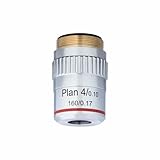 |
AmScope 4X Plan Achromatic Objective Lens with Knurled Ring
|
9.1 |
Read Review |
 |
KP – 0.5X Auxiliary Stereo Microscope Objective Lens -…
|
8.9 |
Read Review |
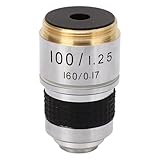 |
Hilitand 100X Microscope Objective, Brass Aluminum Alloy Material, Microscope…
|
8.7 |
Read Review |
 |
Achromatic Microscope Objective, 10X Achromatic Objective Lens, 160/0.17 Biological…
|
8.5 |
Read Review |
 |
100X Microscope Objective Lens Replacement High Power 20.2mm Interface…
|
8.4 |
Read Review |
 |
AmScope 4X-100X Four Achromatic Objective Lens Set
|
8.2 |
Read Review |
Quick Review For Top 9 Objective Microscope
AmScope A100X 100X (Oil) Achromatic Microscope Objective
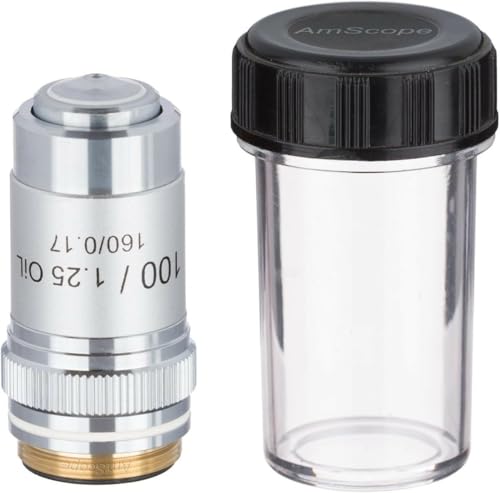
The AmScope A100X 100X (Oil) Achromatic Microscope Objective is a high-power lens designed for serious microscopic work. It provides a full 100X magnification, which is essential for viewing extremely small specimens like bacteria, blood cells, or intricate details in tissue samples. This isn’t a simple magnifying glass; it’s a precision optical instrument. The achromatic corrections built into the lens are key.
They minimize color fringing and distortion, giving you sharp, clear images with true-to-life color fidelity. This means what you see is an accurate representation of your sample, which is crucial for both education and professional analysis.
A major feature of this objective is its high Numerical Aperture (NA) of 1.25. In simple terms, a higher NA allows the lens to gather more light from the specimen.
This results in superior resolution and brighter images, especially important at such high magnification where detail can easily be lost. To achieve this optimal performance, the A100X requires oil immersion. You place a special immersion oil between the lens and the slide. This oil has a similar refractive index to glass, which reduces light scattering and maximizes resolution and clarity at the highest power.
AmScope A10X 10X Achromatic Microscope Objective

The AmScope A10X 10X Achromatic Microscope Objective is a core component for anyone looking to upgrade or replace a standard 10x lens on their compound microscope. This objective is brand new and built to a high quality standard, offering a reliable and clear view of your specimens.
If your work or hobby involves looking at slides regularly, having a dependable objective like this is crucial for consistent results.
Its 10X magnification power is one of the most commonly used levels in microscopy. It sits perfectly between the lower power scanning objective and the higher power lenses, providing a great balance between field of view and detail.
You can use it to get a broader look at a sample before zooming in closer, or it might be the perfect standalone power for certain educational or inspection tasks. It’s a fundamental magnification that you’ll likely use very often.
The fact that it’s an achromatic objective lens is a key feature for image quality. Achromatic lenses are corrected to bring two colors of light (typically red and blue) to a common focus.
AmScope A5X 5X Achromatic Microscope Objective

The AmScope A5X 5X Achromatic Microscope Objective is a specific component designed to upgrade or replace an objective on your compound microscope. If your microscope uses DIN standard objectives, this lens is made to fit right in and provide a reliable, intermediate level of magnification. It’s not a standalone product; it’s a part for your existing system, so compatibility is the first thing to check.
Let’s break down what those features mean for you.
The 5X magnification power fills a useful gap between the common 4X scanning lens and the 10X low-power lens. This can be really helpful for getting a broader, yet still detailed, view of your specimen before zooming in further. It gives you another option for surveying slides, especially when the 4X is too wide and the 10X is too close. You’ll appreciate having this middle step for a smoother examination process.
The term “Achromatic” is a key quality indicator.
Achromatic lenses are corrected for color. In simpler terms, they reduce the chromatic aberration—that colored fringe or halo you sometimes see around edges in the image. This correction leads to a clearer, sharper, and more true-to-color view compared to a non-corrected lens. For most educational, hobbyist, and professional lab work, an achromatic objective provides the ideal balance of performance and value.
The engraving “5/0.1 and 160/0.17” contains important specs.
AmScope 4X Plan Achromatic Objective Lens with Knurled Ring
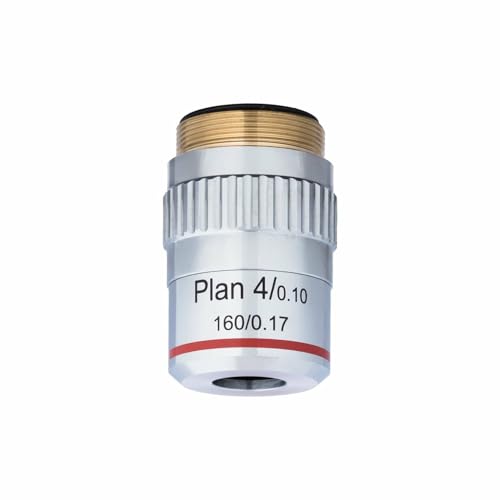
The AmScope 4X Plan Achromatic Objective Lens with Knurled Ring is a fundamental component for anyone using a compound microscope for detailed observation. This objective lens is designed to provide a clear, wide-field view of your specimen, serving as the starting point for most microscopic examination. Its 4X magnification is perfect for getting an initial overview of a slide, allowing you to locate and center areas of interest before zooming in with higher power objectives.
This makes it an essential first step in any systematic study, weather you’re in an educational, hobbyist, or professional lab setting.
One of the key features of this lens is its Plan Achromatic optical design. This means it is corrected for two common types of optical distortion: spherical and chromatic aberration. The “plan” correction ensures the field of view is flat and in focus from the center all the way to the edges, not just in the middle.
The “achromatic” correction minimizes color fringing, so you get a clearer, more true-to-life image with better contrast and detail. For a 4X objective, this level of correction provides a notably sharper and more reliable starting image than a standard achromat might.
The technical specifications are important for compatibility. With a Numerical Aperture (NA) of 0.10, this lens is optimized for its magnification level, balancing resolution and working distance.
KP – 0.5X Auxiliary Stereo Microscope Objective Lens – 1-7/8" 48mm Mounting

The KP 0.5X Auxiliary Stereo Microscope Objective Lens is a practical accessory designed to enhance the functionality of your existing stereo microscope. If your work or hobby involves detailed inspection, soldering, or assembly, this lens modifies two key aspects of your microscope’s performance: magnification and working distance. It’s a straightforward tool that can make a significant difference in your viewing experience.
This lens provides a 0.5X magnification factor.
That might sound like it reduces power, but its purpose is to effectively widen your field of view. You’ll see a larger area of your sample or workpiece at once, which is incredibly helpful for getting a broader context before zooming in on finer details. More importantly, it doubles the magnification of your microscope’s original objectives. For example, if your main scope has a 2X lens, adding this auxiliary objective will give you an effective 1X view.
This extended range offers more flexibility for different tasks.
One of its most valued features is the substantial increase in working distance. The lens can raise the working distance up to 11.21 inches (287mm). This extra space between the objective lens and your subject is crucial. It allows you to use tools, like soldering irons or tweezers, comfortably under the microscope without constantly bumping into the lens.
Hilitand 100X Microscope Objective, Brass Aluminum Alloy Material, Microscope Lens

The Hilitand 100X Microscope Objective is a high-powered lens designed for serious magnification work. If your projects require viewing details at the cellular level or examining minute structures on materials, this 100X objective is the tool that gets you there.
It’s the key component that provides the final, powerful stage of magnification on a compound microscope, making tiny worlds visible and clear.
Constructed from a brass aluminum alloy, this lens barrel offers a specific blend of benifits. The alloy provides excellent durability and stability, which is crucial for maintaining precise optical alignment. Unlike some plastics, this metal construction resists warping and can handle the careful handling required in a lab or workshop setting.
It also gives the objective a substancial, quality feel that instills confidence during use. The materials chosen help ensure the lens stays securely parrallel to your specimen for consistent viewing.
This objective is primarily intended for use on standard compound microscopes that utilize RMS-threaded objectives. That’s the most common threading type, but its always wise to double-check your microscope’s nosepiece compatibility before purchasing.
Achromatic Microscope Objective, 10X Achromatic Objective Lens, 160/0.17 Biological Microscope Achromatic Objectives Lens, for Biological Microscope

The Achromatic Microscope Objective, 10X Achromatic Objective Lens is a core component for anyone using a biological microscope. This specific objective is designed to fit standard microscopes with a 160mm tube length and require a cover slip thickness of 0.17mm, which are common specifications in labs and educational settings.
Its primary job is to provide the first major level of magnification, bringing your biological samples into clear, detailed view for further study.
Let’s break down what ‘achromatic’ means for you. When light passes through a simple lens, it can seperate into colors, creating fringes of color around your sample image. This is called chromatic aberration, and it blurs details. This 10X objective is specifically engineered to correct for this.
It brings two colors of light (typically red and blue) into a common focus, significantly reducing that color distortion. The result is a much clearer, higher contrast image where the true structures of your cells or tissues are easier to distinguish. You get a more accurate picture without those distracting color halos.
Durability is key for lab equipment. This objective features a shell made from precision-machined aluminum alloy.
100X Microscope Objective Lens Replacement High Power 20.2mm Interface for Compound Microscopes Brass Chrome Plated

The 100X Microscope Objective Lens Replacement is a high-power component designed to upgrade the capabilities of your existing compound microscope. If your work or study requires viewing extremely fine details, like cellular structures or bacteria, this lens provides the necessary magnification to bring those details into sharp focus.
It’s a direct replacement part, meaning you can swap it with a lower-power objective on your microscope’s nosepiece, instantly enhancing your instrument’s range without needing a whole new setup.
This objective offers a true 100X magnification, which is essential for high-resolution observation in fields like biology, medicine, or education. The lens is coated with a special material that increases light transmittance and refractive index.
This means more light passes through to your eyes or camera, resulting in a brighter, clearer, and more detailed image compared to uncoated or lower-quality lenses. The specified common rail distance is approximately 195mm, and it maintains a parfocal distance of about 45mm, which helps keep the image in rough focus when you switch between objectives on your microscope.
Built for durability and safety, the lens is constructed from high-quality brass and features a chrome-plated shell.
AmScope 4X-100X Four Achromatic Objective Lens Set
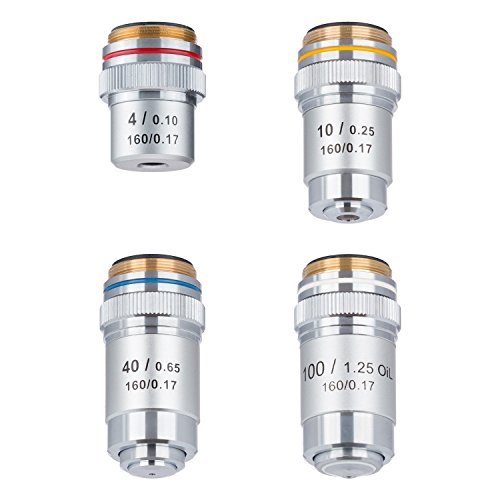
The AmScope 4X-100X Four Achromatic Objective Lens Set is a core upgrade or replacement kit for your standard compound microscope. If your existing objectives are damaged, or if your looking to improve image clarity across a range of magnifications, this set provides the essential lenses for most viewing tasks.
Its designed to be a straightforward, functional solution without unnecessary complexity.
This set includes four individual objective lenses: 4X, 10X, 40X, and 100X (oil immersion). These are the most common magnifications used in biological and educational microscopy. The 4X lens gives you a wide field of view for locating your specimen. You then use the 10X for a broader examination. The 40X lens provides high-detail observation of cell structures.
Finally, the 100X oil immersion lens allows for the highest magnification to see fine details like bacteria or cellular organelles. Having this full range on your microscope’s nosepiece means you can seamlessly transition between magnification levels during your work.
A key feature of these lenses is there achromatic correction. In simple terms, this means they are engineered to reduce optical imperfections known as chromatic aberration.
Objective Microscope Buying Guide
An objective microscope lens is selected based on these parameters. It’s teh part that sits closest to your sample, and choosing the right one is crucial for a clear, useful image. Don’t worry, it’s simpler than it seems once you know what to look for.
Magnification and Numerical Aperture
What magnification do you need? Common options are 4x, 10x, 40x, and 100x. But here’s the key: also check the Numerical Aperture (NA). A higher NA means better resolution and more light gathered. A 40x lens with a high NA will show more detail than one with a low NA. It’s a balance of power and clarity.
Lens Correction and Image Flatness
Have you ever seen a blurry image around the edges? That’s a sign of poor lens correction. For most work, a plan or semi-plan objective is best. These lenses produce a flat, crisp image across the entire field of view, which is essential for photography or detailed observation. Standard achromat lenses are more budget-friendly but may have some curvature.
Working Distance
This is the space between the lens and your specimen when it’s in focus. If you’re working with thick slides or need to manipulate a sample under the lens, a longer working distance is a lifesaver. A high-magnification lens often has a very short working distance, which can be frustrating. Always consider what you’ll actually be looking at.
Microscope Compatibility
Not all objectives fit all microscopes. The most critical detail is the thread size, with RMS (Royal Microscope Society) being a common standard. Also, check if your microscope requires parfocal lenses—lenses that stay in focus when you switch between them. Mixing incompatible optics leads to poor results and wasted money.
Frequently Asked Questions About Objective Microscope
What is an objective microscope?
An objective microscope is a high-powered lens that sits close to the sample you’re viewing. It’s the part that actually creates the magnified image. You usually have several on a rotating turret to choose different zoom levels.
What do the numbers on the lens mean?
You’ll see numbers like 4x, 10x, 40x, and 100x. This is the magnification power. A 10x lens makes the sample appear ten times larger. The other number, like 0.25, is the numerical aperture (NA). A higher NA generally means a sharper, more detailed image.
What’s the difference between parfocal and achromatic objectives?
Parfocal means when you switch between objectives, the sample stays mostly in focus. Achromatic lenses are corrected for color, so you see less of a rainbow fringe around edges. They’re common and good for general use.
Why are some objectives so much longer than others?
Longer objectives often have a higher working distance. This is the space between the lens and your sample. You need more space if you’re looking at thick slides or using tools under the microscope.
Can I use any objective on my microscope?
Not always. You need to check the thread size, usually RMS standard, and the parfocal length. Using an incompatible one can mean it won’t screw in or it won’t reach focus properly. Always check your microscope’s manual.
What does ‘oil immersion’ mean?
Some high-power objectives, like 100x, require a special oil between the lens and the slide. This oil helps capture more light for a clearer image. Remember to clean the lens carefully after use, or the oil can damage it.
How do I clean an objective lens?
Use a soft lens brush or air blower first to remove dust. For smudges, use a small amount of lens cleaner on special lens paper. Gently wipe in a circle. Never use regular tissue or your shirt, as thay can scratch the delicate glass.
Last Thoughts Before You Buy
Your core imaging component is crucial; choose wisely. Think about what you’ll be looking at most often. A good fit makes your work smoother and more accurate. It saves you time and frustration in the long run. Consider your budget, but remember this is a key tool. Investing in the right quality pays off.
In the end, the best choice is the one that meets your specific needs. Don’t get distracted by features you won’t actually use. Focus on clarity, reliability, and the support behind the product. A well-chosen objective microscope becomes a trusted partner in your work, providing the clear view you need for years to come. Take your time to decide.