Enhance your celestial views with precision optical accessories. You’ve got your telescope, but the real magic often begins with the right telescope filters. They’re not just add-ons; they’re essential tools that cut through glare and boost contrast, transforming a fuzzy blob into a stunning, detailed planet.
Think of them as specialized lenses for the cosmos. Whether you’re battling city lights or trying to see the delicate veils of a nebula, a simple filter can make all the difference. Let’s explore which ones belong in your kit and how they can unlock the true potential of your nights under the stars.
Product Comparison Table: 9 Best Telescope Filters
| Image | Why We Like This Product | Editor’s Rating | |
 |
Celestron 1.25 inch Moon Filter – Suitable for Lunar…
|
9.7 |
Read Review |
 |
Celestron Accessory Kit with Five 1.25″ Plossl Eyepieces, 2x…
|
9.5 |
Read Review |
 |
SVBONY Telescope Filter 1.25″ UHC Filter Astrophotography to Improve…
|
9.3 |
Read Review |
 |
SVBONY SV220 Telescope Filter, 2″ 7nm Dual-Band Nebula Filter,…
|
9.1 |
Read Review |
 |
SVBONY SV220 Telescope Filter, 7nm Dual-Band Nebula, H-Alpha and…
|
8.9 |
Read Review |
 |
SVBONY Telescope Filter 1.25 inches Variable Polarizing Filter for…
|
8.7 |
Read Review |
 |
Celestron 94123 1.25-inch UHC/LPR Filter with Multi-Layer Dielectric Coatings…
|
8.5 |
Read Review |
 |
CelticBird Telescope Accessory Kit – 1.25″ Telescope Eyepiece and…
|
8.3 |
Read Review |
 |
SVBONY SV260 Telescope Filter, 2” Multi-bandpass Star Field Filter,…
|
8.1 |
Read Review |
Quick Review For Top 9 Telescope Filters
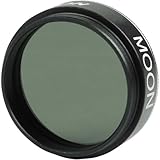
Celestron 1.25 inch Moon Filter – Suitable for Lunar Observation, Extra Bright Planets or Terrestrial Viewing Over Sand or Snow, Black

The Celestron 1.25 inch Moon Filter (Model 94119-A) is a simple but essential tool for anyone who enjoys looking at the night sky. If you’ve ever tried to observe a full Moon through your telescope, you know how overwhelmingly bright it can be. That intense glare washes out detail and can actually be uncomfortable for your eyes. This filter screws directly onto your 1.25-inch eyepiece to solve that exact problem.
Its primary job is to cut down the Moon’s brilliant light, allowing you to observe for longer periods in much greater comfort. By reducing the glare, it also significantly increases contrast. This means you’ll see more definition in lunar features—the subtle shading of maria (the dark “seas”), the rugged texture of crater walls, and the delicate rays extending from impacts like Tycho become much more distinct and easier to study. It turns a blinding disk into a detailed, fascinating world.
While it’s called a Moon filter, its usefulness doesn’t stop there. The filter is also excellent for viewing extra-bright planets. Venus and Jupiter, for instance, can benefit from a slight reduction in brightness, potentially revealing more atmospheric detail on Jupiter or a more defined phase of Venus without the harsh shine. Another clever application is for terrestrial, or daytime, viewing over exceptionally bright backgrounds.
Celestron Accessory Kit with Five 1.25" Plossl Eyepieces, 2x Barlow and Filter Set

The Celestron Accessory Kit with Five 1.25″ Plossl Eyepieces, 2x Barlow and Filter Set is designed to be a comprehensive upgrade for your telescope viewing sessions. It bundles together the most commonly used eyepieces and filters into one organized package, saving you the hassle of piecing together a collection on your own.
The idea is to give you the right tools to see more detail on the Moon, planets, and deep-sky objects without needing to search for each component seperately.
At the heart of the kit are five Plossl eyepieces. These are known for their reliable, four-element optical design which provides sharp views across a 52-degree field. You get a range of focal lengths: 32mm, 17mm, 13mm, 8mm, and 6mm.
This spread covers low-power views for wide celestial fields and high-power magnification for scrutinizing planetary details. The construction is solid, with standard 1.25-inch barrels that fit most amateur telescopes.
A key feature is the included 2x Barlow lens. This accessory effectively doubles the magnification of any eyepiece you attach it to. When you pair it with the five eyepieces in this kit, it instantly gives you ten different magnification options.
SVBONY Telescope Filter 1.25" UHC Filter Astrophotography to Improve The Image Contrast Reduces Light Pollution (1.25 inch)
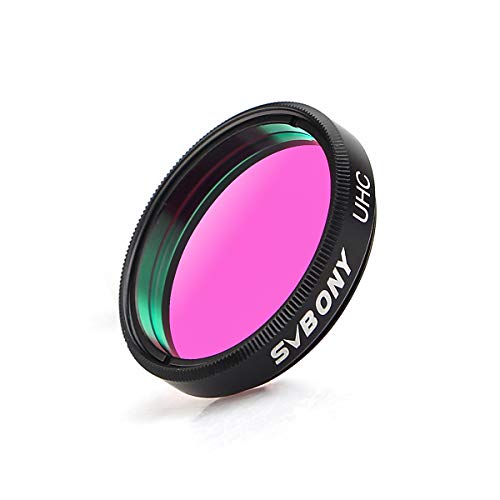
The SVBONY Telescope Filter 1.25″ UHC Filter is a tool designed for astronomers who want to see more from their night sky, especially if you’re dealing with the glow of city or suburban lights.
It’s a specific type of filter known as an Ultra High Contrast (UHC) filter, and its primary job is to help you cut through light pollution to reveal the faint, delicate structures of deep-sky objects.
So how does it work? The filter is precision-engineered to selectively block certain wavelengths of light. These are typically the wavelengths emitted by common artificial sources like streetlights.
By reducing this intrusive glow, the filter darkens the overall background of the sky in your eyepiece. This isn’t about making things brighter; it’s about improving contrast. When the sky background is darker, the contrast of emission nebulae becomes significantly more noticeable. These nebulae, which glow in specific colors like red hydrogen-alpha and blue-green oxygen-III, are allowed to pass through the filter more freely.
SVBONY SV220 Telescope Filter, 2" 7nm Dual-Band Nebula Filter, Reduce Stray Light, H-Alpha&O-III Narrowband Filter for One-Shot Color Camera, Telescope Accessories for Deep Sky Astrophotography

The SVBONY SV220 Telescope Filter is a specialized tool designed for one very specific and challenging task: capturing detailed images of nebulae from less-than-ideal locations. If you’re an astrophotographer dealing with the constant glow of city lights or the bright wash of a full moon, this filter aims to be a game-changer for your deep-sky work.
At its core, the SV220 is a 2-inch, 7nm dual-band filter.
This technical description means it’s built to be incredibly selective about the light it lets through to your camera sensor. It allows over 94% of two key wavelengths to pass: the H-Alpha line at 656.3nm and the O-III line at 500.7nm. These are the primary emission lines given off by many emission nebulae. Crucially, it aggressively blocks out the common wavelengths of artificial light pollution and natural skyglow.
This selective process is what helps you capture purer signal from your celestial target.
The practical result is a significant improvement in image contrast. By supressing the unwanted background glow, the nebulae structures themselves pop with more detail and definition. This can save you immense amounts of time during post-processing, as your initial data is cleaner and has better contrast straight from the camera.
SVBONY SV220 Telescope Filter, 7nm Dual-Band Nebula, H-Alpha and O-III Narrowband Filter for One-Shot Color Cameras, Reduce Light Pollution for Astrophotography (1.25 inches)

The SVBONY SV220 7nm Dual-Band Nebula Filter is a specialized tool designed for astrophotographers using one-shot color cameras. Its primary job is to isolate specific wavelengths of light emitted by nebulae, while blocking out a significant portion of unwanted light pollution.
This means you can capture clearer, more detailed images of deep-sky objects even from locations where the night sky isn’t perfectly dark.
If you live in or near a city, you know how challenging bright streetlights and a bright moon can be for astronomy. The SV220 filter directly addresses this. It cuts through that interference, allowing the faint glow of nebulae to come through.
It doesn’t make the nebula itself brighter, but by darkening the background sky, the contrast is dramatically improved. This increase in contrast is what makes your astrophotography subjects stand out so much more clearly in your final images.
The “dual-band” part of its name is key. This single filter transmits light from two important emission lines: Hydrogen-Alpha (H-α) and Oxygen-III (O-III). These are the primary gases that make up many emission nebulae.
SVBONY Telescope Filter 1.25 inches Variable Polarizing Filter for Astronomical Telescope Eyepiece

The SVBONY Telescope Filter 1.25 inches Variable Polarizing Filter is a tool designed to give you control over your lunar and planetary viewing. If you’ve ever found the Moon’s brightness overwhelming through your telescope, washing out subtle details, this filter addresses that exact issue. It’s not a fixed filter; its variable design means you can adjust the view to match the conditions and your personal comfort.
This filter threads directly onto any standard 1.25-inch eyepiece, fitting the common M28.5 x 0.6 thread size. Once attached, you simply rotate the filter housing to finely control the amount of light passing through. The transmission can be adjusted from a very dim 1% all the way up to 80%, giving you a much wider range than a single fixed-density moon filter. This finer control is key for finding the perfect brightness for studying craters, seas, and other lunar features in detail.
By cutting down glare and reducing the light entering the eyepiece, the filter significantly increases contrast. The product information states it allows only about 13 percent of reflected light through at a typical setting, which reduces eye strain and lets you observe for longer periods in greater comfort. The enhanced contrast helps bring out surface details that might otherwise be lost in the brightness.
Celestron 94123 1.25-inch UHC/LPR Filter with Multi-Layer Dielectric Coatings – Optimises Spectral and Optical Characteristics for Improved Celestial Viewing, Black
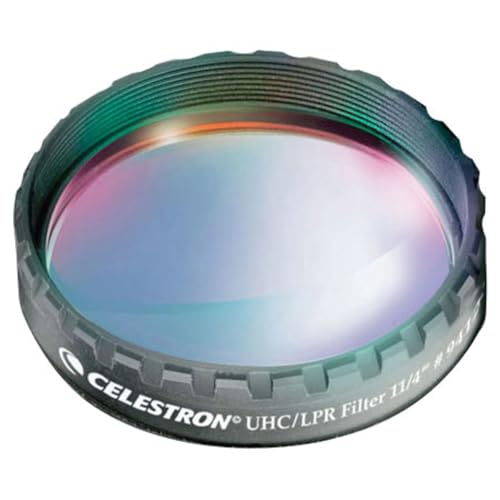
The Celestron 94123 1.25-inch UHC/LPR Filter is a tool designed to help you see more in the night sky from where you actually are. If you do most of your observing from a backyard or a location with some streetlights, you know how washed-out the view can become. This filter adresses that core challenge directly.
It’s specifically engineered as a Light Pollution Reduction, or LPR, filter. What that means is it doesn’t just dim everything equally.
Instead, it works by selectively blocking certain wavelengths of light that are common in artificial lighting, like the yellow-glow from sodium-vapor lamps or the harsh white from LEDs. By filtering these out, it increases the contrast of the celestial objects you want to see. The background sky will appear darker, while nebulae and galaxies can stand out more clearly.
It’s important to manage expectations, though—it won’t make light pollution dissapear, but it can significantly improve the signal-to-noise ratio of your view.
The “UHC” part of its name stands for Ultra High Contrast. This indicates it’s particularly tuned for emission nebulae, like the Orion Nebula or the Lagoon Nebula. These objects emit light at very specific wavelengths, and the filter allows that light to pass through while blocking others.
CelticBird Telescope Accessory Kit – 1.25" Telescope Eyepiece and Filter Set with a Sturdy Carry Case – Five Plossl Eyepieces, 2X Barlow Lens and Seven Filters

The CelticBird Telescope Accessory Kit is a comprehensive 1.25-inch set designed to expand what you can see and photograph with your telescope. It bundles the essential optical components many astronomers accumulate over time into one convenient package, offering significant value compared to purchasing each item individually.
At the heart of the kit are five Plossl eyepieces. These are a standard, reliable design providing good clarity.
With focal lengths of 40mm, 20mm, 12.5mm, 8mm, and 6mm, they cover a wide range of magnifications. The 40mm is great for wide-field views of star clusters and nebulae, while the higher-power 6mm and 8mm eyepieces bring the moon and planets in for a closer look. Having this selection means you can quickly switch between sweeping vistas and detailed planetary observation without missing a beat.
To effectively double your eyepiece collection, the included 2X Barlow lens is a key piece.
When you insert any of the eyepieces into the Barlow lens, it doubles that eyepiece’s magnification. This instantly gives you more viewing options, like turning your 20mm eyepiece into a 10mm. The Barlow also features T-threads (M42x0.75), which is crucial for astrophotography.
SVBONY SV260 Telescope Filter, 2'' Multi-bandpass Star Field Filter, 90% Light Transmittance, Cut-Off Depth OD4, Telescope Accessory for Reflection Nebula Galaxy Suburb Astrophotography
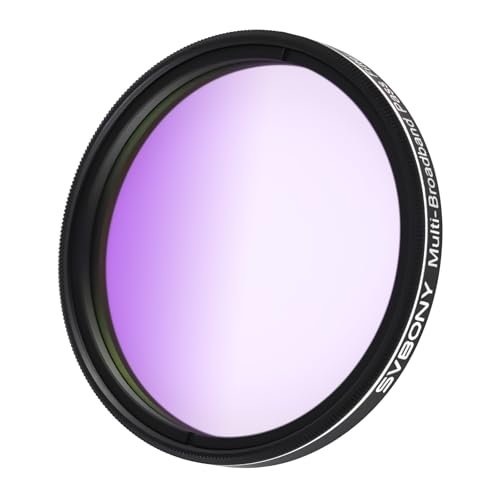
The SVBONY SV260 Telescope Filter is a 2-inch multi-bandpass filter designed to tackle a common problem for astrophotographers: light pollution. If you shoot from a suburban or city location, the glow from streetlights and other sources can wash out the delicate details and colors of deep-sky objects. This filter aims to help you cut through that interference to capture clearer, more vibrant images of the night sky. Its core function is as a broadband light pollution filter.
It works by allowing specific wavelengths of light, crucial for astrophotography, to pass through while blocking others associated with common artificial lights. The SV260 features a multi-bandpass design that targets five key transmission bands. This means it doesn’t just block unwanted light; it strategically lets in the light you actually want from emission nebulae, stars, and galaxies.
With a peak light transmittance of over 90%, it minimizes the loss of this desirable light, helping to preserve the true color and brightness of your celestial targets. A key specification is its OD4 cut-off depth. This refers to how effectively it blocks the light pollution wavelengths it’s designed to suppress. An OD4 rating indicates strong suppression, providing a darker background in your images which makes your subject—like a reflection nebula or a distant galaxy—stand out more clearly.
Telescope Filters Buying Guide
Filters are essential tools for enhancing planetary and lunar views. They screw into the bottom of your eyepiece and work by blocking specific wavelengths of light. This simple action can dramatically improve contrast, reduce glare, and reveal details you’d otherwise miss. Choosing the right telescope filters, however, depends on what you want to see.
Filter Color & Purpose
Color is your primary guide. A red filter is fantastic for bringing out dark markings on Mars or details in Jupiter’s belts. For Venus’s cloud structure or lunar crater contrasts, try a blue filter. A neutral density or “moon” filter is a great first buy—it simply cuts down the moon’s intense brightness, making it more comfortable to view for long periods.
Thread Size Compatibility
This is crucial! Check the barrel of your eyepieces for a number like “1.25”” or “2””. Your filter must match this thread size. An adapter can sometimes bridge the gap, but it’s best to get the correct size from the start to avoid vignetting or the filter not screwing on at all.
Optical Quality & Coatings
Not all glass is created equal. Higher-quality filters use optically flat glass with anti-reflection coatings. This prevents internal reflections and ensures maximum light transmission for the wavelengths you *want* to see. A cheaper, uncoated filter might introduce unwanted glare or color casts, dimming the view more than necessary.
Specialized vs. Broadband Filters
Beyond basic colors, consider specialized filters. A narrowband “O-III” filter is a game-changer for viewing certain nebulae, like the Ring Nebula, from light-polluted skies. For general deep-sky viewing and light pollution reduction, a broadband “Light Pollution Reduction” (LPR) filter can be very helpful. Know your main targets to choose wisely.
Frequently Asked Questions About Telescope Filters
What does a telescope filter actually do?
A telescope filter changes teh light that enters your eyepiece. It’s a small piece of glass or material that screws into the bottom of your eyepiece. They can block specific colors of light or reduce brightness to improve contrast and reveal details.
What’s the most useful filter for a beginner?
A moon filter is often the best first buy. The moon is very bright through a telescope, and this filter cuts the glare. It makes viewing more comfortable and helps you see surface details better without that harsh light.
What’s the difference between a planetary filter and a light pollution filter?
Planetary filters are colored (like red, blue, or green). They enhance specific features on planets, like the clouds belts on Jupiter. A light pollution filter blocks common artificial street lights. It helps improve the view of nebulae from a city or suburb.
Can I use more than one filter at a time?
Technically, yes, you can stack them. But it’s not usually recommended. Adding multiple pieces of glass can degrade the image quality and make things to dim. It’s better to use one quality filter designed for your specific target.
How do I know if a filter will fit my eyepieces?
Check the barrel size of your eyepieces. The most common sizes are 1.25-inch and 2-inch. Filters have threads on both sides, so a 1.25-inch filter will fit any 1.25-inch eyepiece. Just make sure you note the size before ordering.
Are expensive filters worth the cost?
For casual viewing, a mid-range filter from a reputable brand works great. Higher-end filters use better coatings and glass for maximum light transmission. The difference is subtle but noticeable on delicate details, especially for astrophotography.
Do I need a special filter to look at the sun?
Absolutely yes. You must use a proper solar filter that fits over the front of your telescope. Never use a standard eyepiece filter for solar viewing. It’s incredibly dangerous and can cause permanent eye damage or even start a fire.
Before You Decide
To enhance planetary views, add one of these accessories. A sturdy carrying case protects your gear during transport. A set of different eyepieces lets you switch magnifications easily. This is key for seeing a planet’s full disk or zooming in on its details. A good star chart or planetarium app helps you find your targets quickly. Don’t forget a red flashlight to protect your night vision while you read your charts. These simple tools make your observing sessions smoother and more rewarding.
Remember, teh atmosphere affects what you see. Some nights the air is steady, and views are sharp. Other nights, it’s turbulent and details get blurry. Patience is your best tool. Try observing on different nights to get the best results. When the conditions are right, a set of telescope filters can really help. They cut through glare and boost contrast, making features like Jupiter’s bands or Mars’ polar cap stand out more clearly. With the right accessories and a bit of practice, you’ll get the most from your scope.